Every subscription brand has a folder of "lost causes" — failed payments that went through the full dunning sequence and never got resolved. The email sat unopened. The SMS never got a reply. Eventually the case moved to "needs human outreach" or, worse, the subscription just quietly cancelled.
Most merchants treat that folder as the cost of doing business. It isn't. It's a revenue channel that's sitting closed.
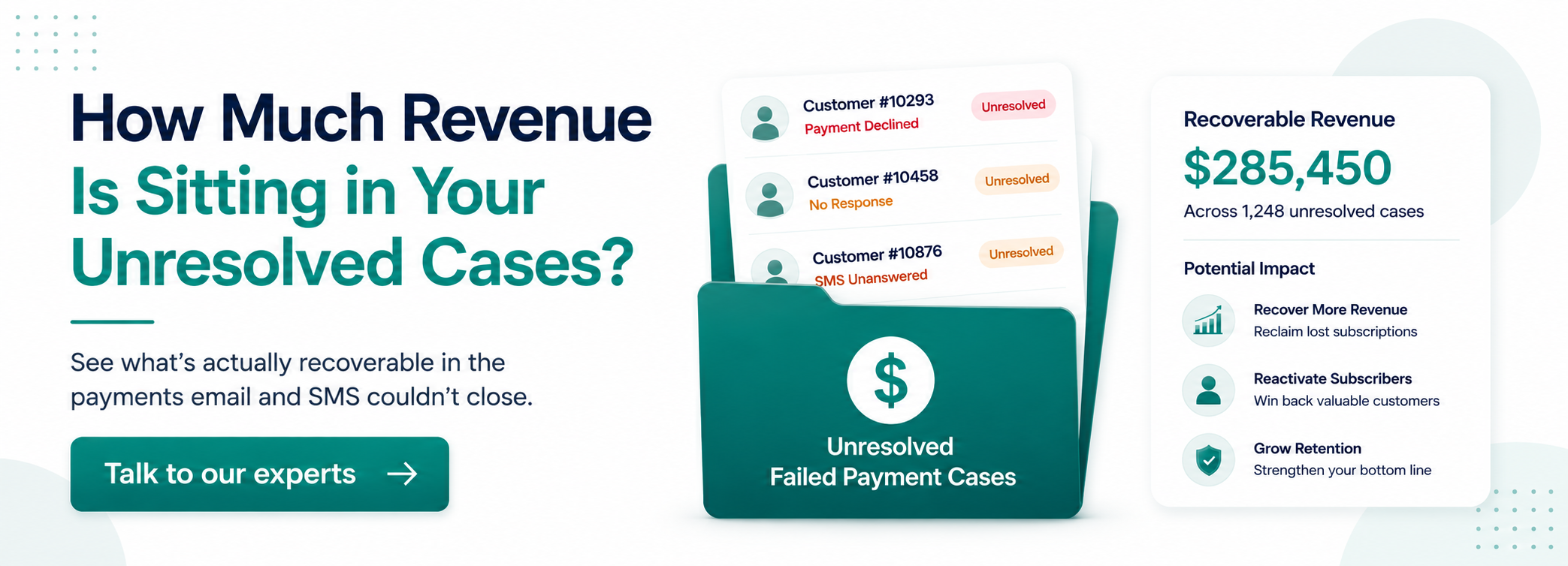
Why Email and SMS Alone Can't Recover Every Failed Payment
This isn't a knock on email and SMS — they're still the right first move for most failed payments, and they resolve a meaningful share of cases on their own. But they share the same fundamental limitation: they depend on the customer noticing, opening, and acting, all in a channel that's easy to ignore.
Industry email marketing benchmarks consistently show that even strong-performing campaigns leave a meaningful percentage of subscribers who never open or engage with recovery emails. That means a large share of subscribers with a failed payment may never even see the message asking them to fix it, not because they don't care about their subscription, but because the email got buried, filtered, or scrolled past.
SMS performs better, but it isn't a silver bullet either. Plenty of subscribers don't opt in, some go quiet mid-sequence, and a text about a declined card competes with everything else pinging their phone that day. What the data does show is that channels compound: research found that combining SMS with a phone conversation pushed answer rates up to 92%, compared to much lower rates for either channel alone. Voice isn't a replacement for email and SMS — it's the channel that reaches the people the other two didn't.
That gap is exactly where subscription revenue disappears. Every one of those unresolved cases was a real customer, with a real card that could likely have been fixed, if someone had actually reached them.
Research from Salesforce shows that customers increasingly expect personalized, connected interactions across every channel they use. AI voice adds that conversational layer to subscription recovery by allowing customers to ask questions, resolve payment issues, and complete updates during the interaction instead of responding to another one-way reminder.

Why This Is a Revenue Channel, Not a Support Feature
It's easy to file "phone calls" under customer service in your head — something reactive, something a support rep does when a customer calls in with a problem. That framing misses what's actually happening here.
An outbound call placed specifically to resolve a failed payment is a recovery action, the same as a retry or a dunning email. It has a direct, measurable outcome: recovered revenue or it doesn't. Treating it as a support nicety instead of a channel in the recovery stack is why most subscription platforms never built it — and why most merchants never think to ask whether it's available.
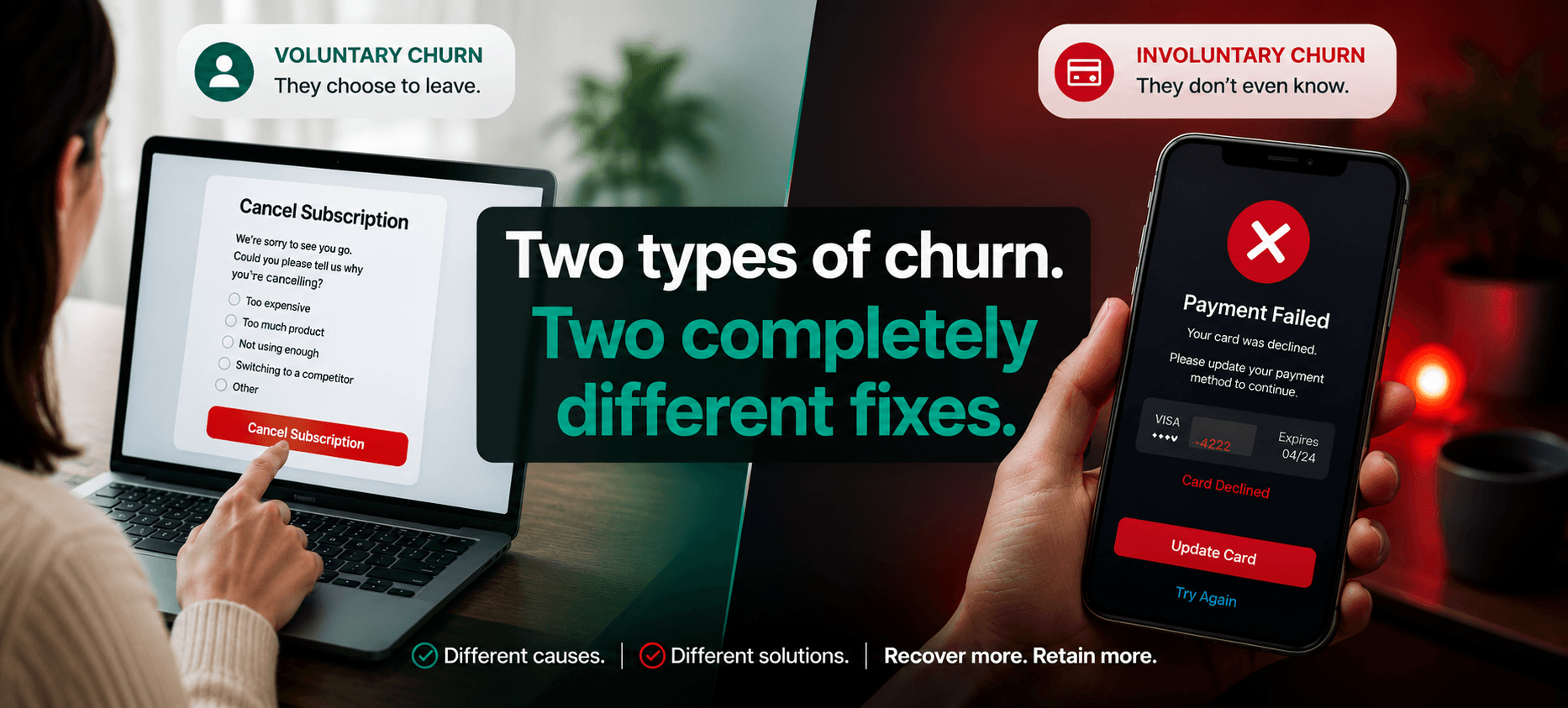
For context on how failed payments get triaged and worked before this point, see how the recovery sequence gets 85% of failed payments back and why voluntary and involuntary churn need to be treated differently — voice becomes most valuable specifically for the involuntary, still-recoverable cases that digital channels couldn't close.
Why AI Voice Calls Recover Payments That Email Can't
A card decline email can only say so much. It's static, one-directional, and easy to misread — is this urgent? Is my subscription cancelled? Is this a scam? A voice conversation resolves all of that ambiguity in real time. The customer can ask a question and get an answer immediately, instead of clicking through to a page that may or may not address their specific concern.
That interactivity matters more than it seems. A customer whose card was declined because of a temporary issue — a bank flag, a spending limit, a stale expiry date they'd genuinely forgotten about — often just needs someone to explain what happened and make it easy to fix. Email can explain. Only a conversation can also answer, reassure, and close the loop in the same interaction.
It also matters for a segment email quietly writes off: subscribers who've gone dark on every channel. Long-tenure customers who stopped opening emails months ago, or who never gave a phone number for SMS but do answer calls, aren't necessarily disengaged from your product — they're just disengaged from your inbox. A voice channel reaches them on different terms.
Why AI Voice Recovery works
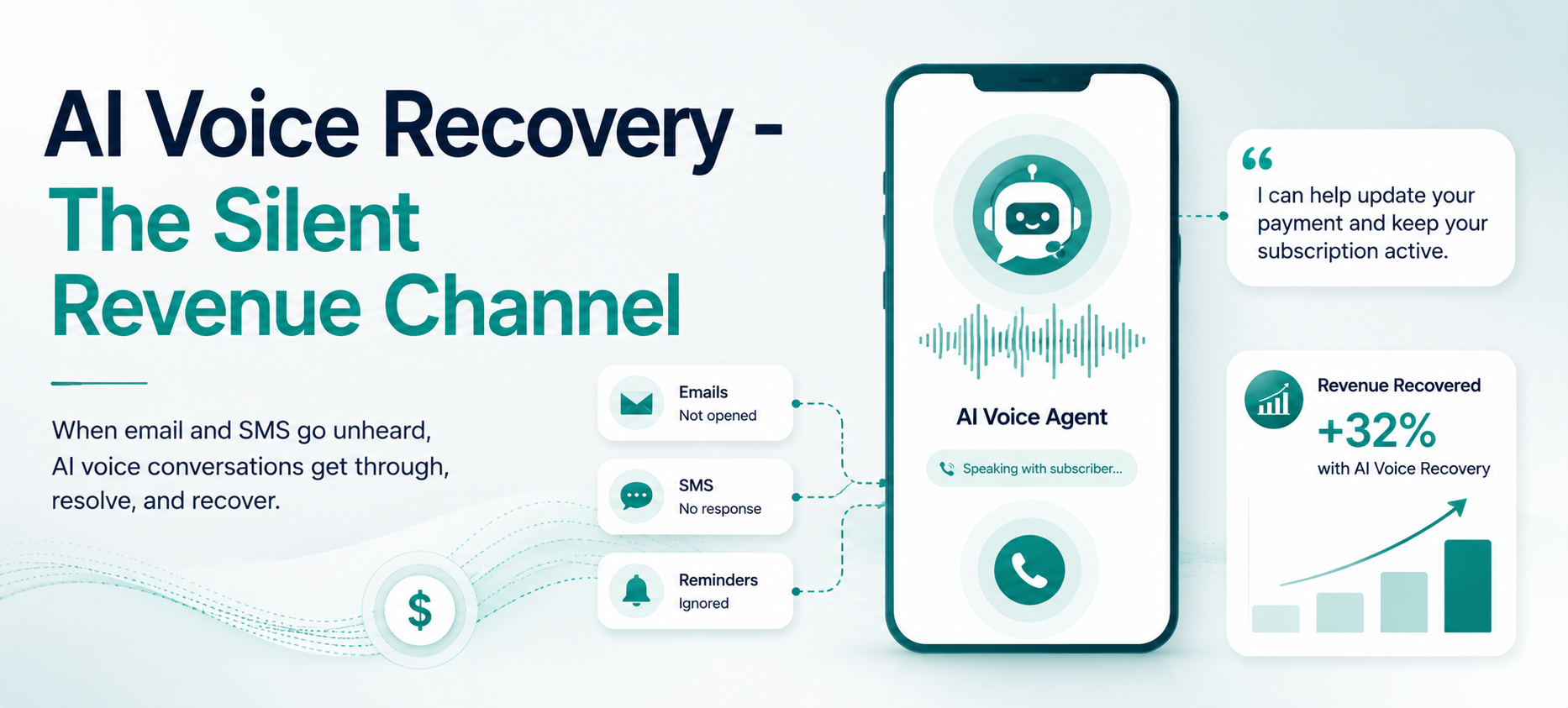
AI Voice recovery reaches subscribers who never engage with email or SMS. Unlike one-way messaging, AI Voice agents can answer questions , explain payment failures, send secure payment-update links during the conversation, and resolve payment issues in real time. For high-value subscribers, voice becomes another recovery channel rather than simply another reminder.
What This Looks Like at enComm
enComm's AI voice calling exists specifically for this gap — payment recovery and high-value winback conversations that email and SMS haven't resolved, or, for higher-value subscribers, as an early recovery step rather than a last resort. It isn't a robocall reading a script. The AI agent has a genuine, real-time conversation, arriving already informed about the customer's product, the reason their payment failed, and what's already been tried — so the customer never has to repeat themselves or explain their own account back to a system that should already know it.
During the call, the agent can send a secure payment update link straight to the customer's phone or email, answer questions about their subscription, and offer a retention deal on the spot if the customer signals they're thinking about cancelling. Every call is placed only within the calling hours a merchant configures, in the customer's own local timezone, and every conversation is recorded with a full transcript available in the dashboard — so nothing about the "silent channel" stays silent to you.
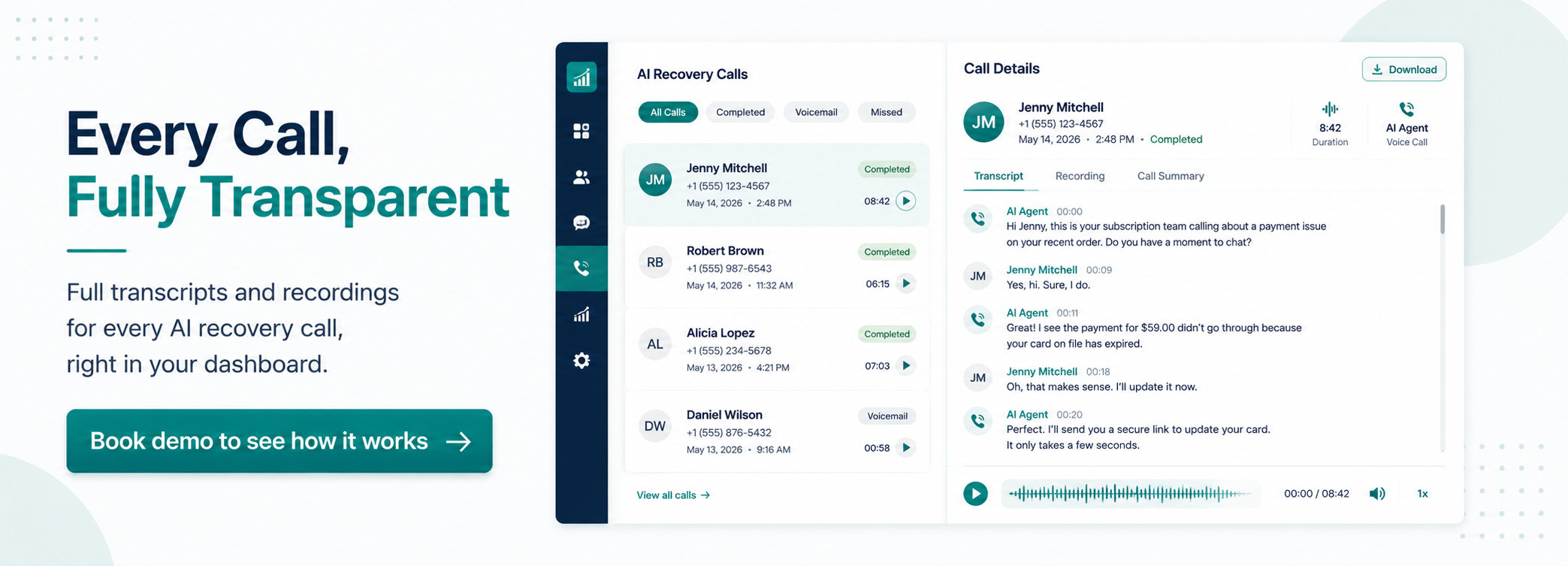
This same voice capability also plays a role after cancellation: for high-value, long-tenure subscribers, an AI call can be the very first winback touchpoint rather than something reserved for later in the sequence, because that relationship warrants a personal approach from the start.
If you want the deeper argument for why AI-driven voice specifically outperforms both scripted human callers and pure digital outreach for transactional conversations like this, we've covered that in detail in why AI voice agents are outperforming both robots and humans for payment recovery. And if you're wondering how voice fits alongside everything else running in the background — retries, classification, cancellation saves — the complete guide to subscription retention and revenue recovery lays out the full system.
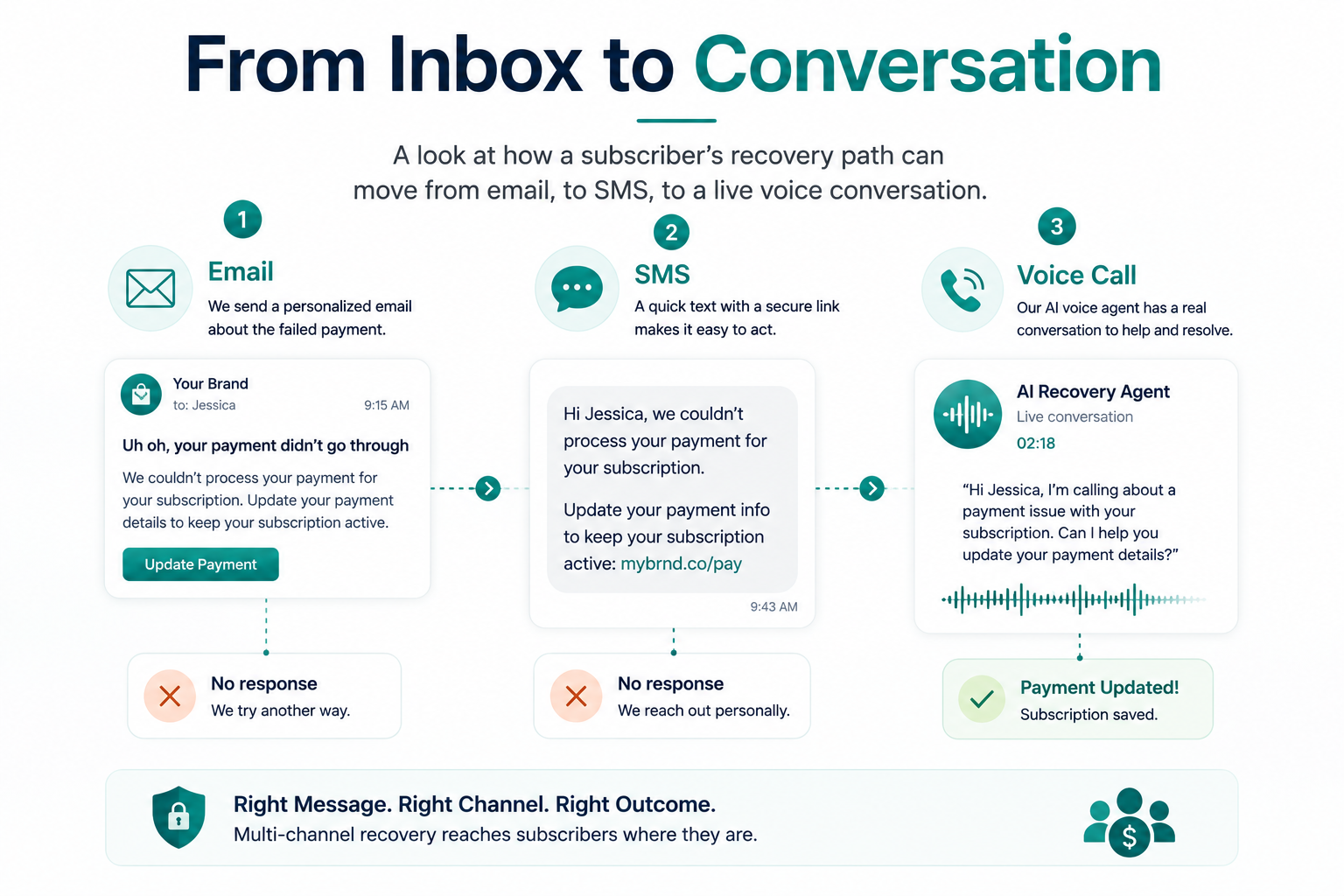
Which Subscription Payment Failures Benefit Most from AI Voice Calls
Not every failed payment needs a phone call — plenty resolve on a well-timed retry or a single email. Voice earns its place specifically for the cases where the digital sequence has run its course without a resolution: high-value customers, hard declines, or subscribers with a pattern of low email and SMS engagement. These are cases that would otherwise land in "needs human outreach," consuming your team's time on manual follow-up, or close as an unrecovered cancellation.
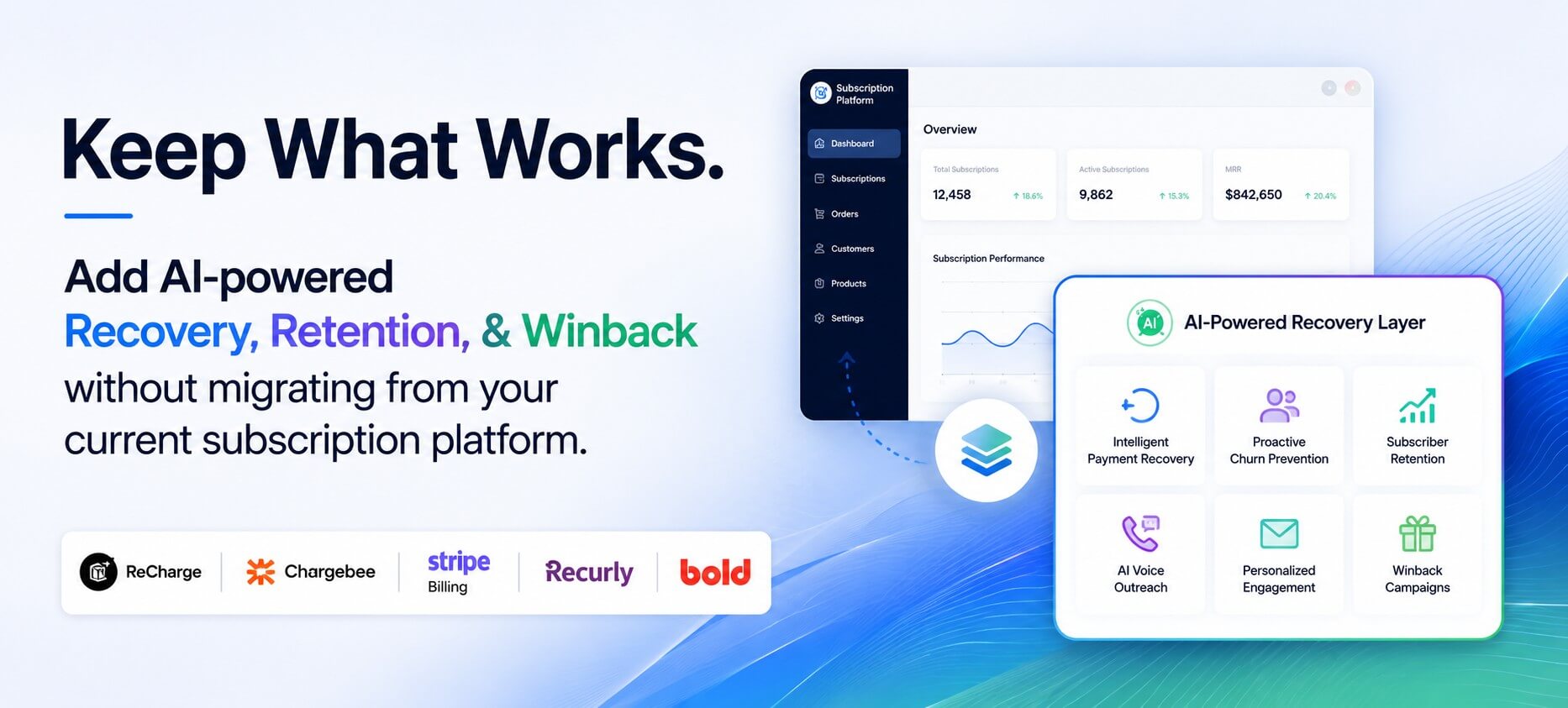
It's also worth remembering that voice doesn't operate in isolation from everything else running underneath it. A customer's payment recovery history, their engagement pattern, and their current subscription status all inform whether — and when — a call makes sense for them, the same context that shapes every other channel in the recovery process. How AI orchestration replaces five separate subscription apps covers how these systems stay connected instead of operating as disconnected tools.
The Bottom Line
If your recovery stack stops at email and SMS, you're not failing to recover 100% of recoverable revenue — you're failing to even attempt recovery on a meaningful slice of it. The subscribers in that gap aren't unrecoverable. They're just unreached. Voice is how you reach them.
Why AI Voice belongs in modern subscription recovery
Modern subscription recovery isn't about choosing between email, SMS or phone calls. It's about matching the communication channel to the customer and the payment issue. AI voice extends existing recovery workflows by reaching subscribers who remain unresolved after digital outreach, helping subscription businesses recover additional revenue without replacing channels already working.