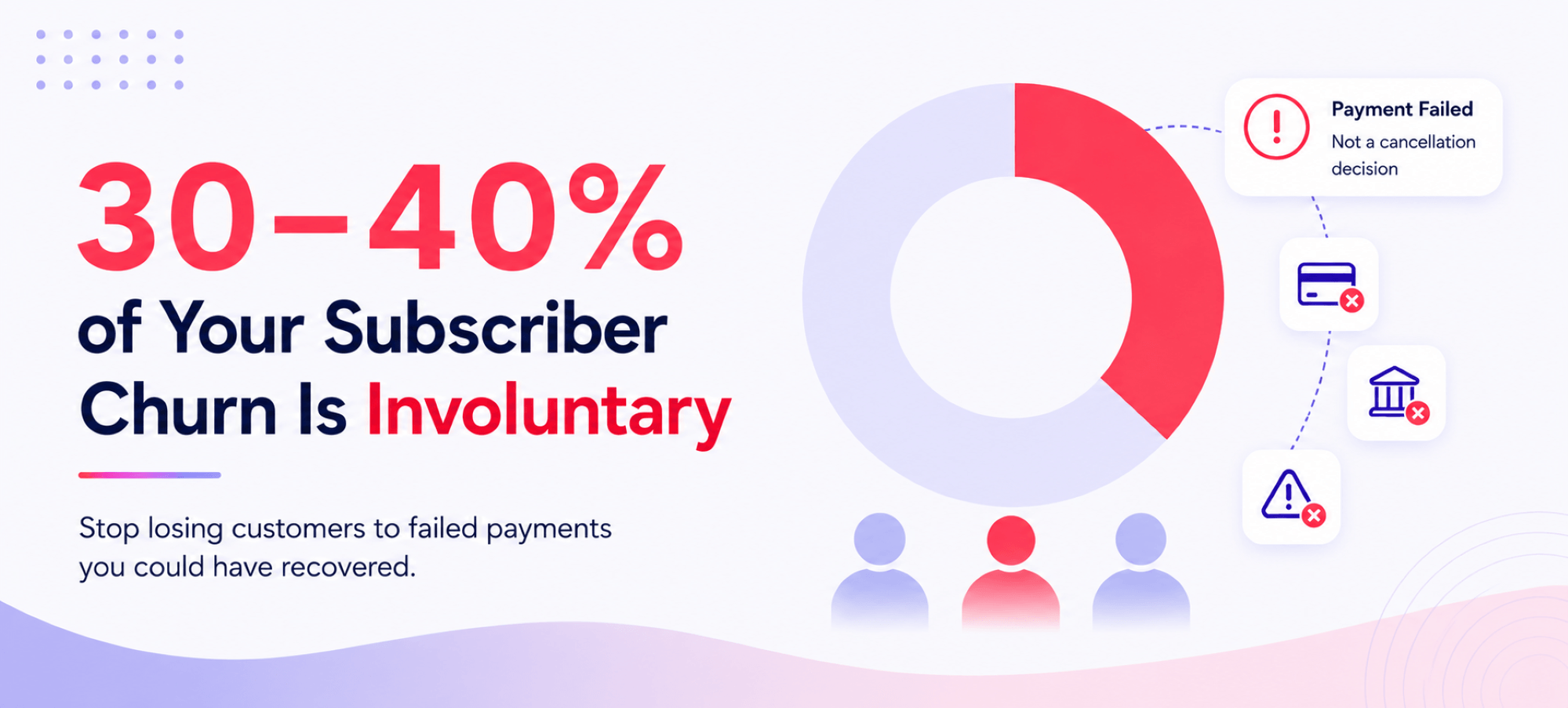
You’re watching your subscriber count drop. You’re running win-back campaigns, A/B testing your onboarding, maybe even questioning your pricing. But what if a significant chunk of that churn had nothing to do with your product at all?
The Revenue Leak Nobody Talks About
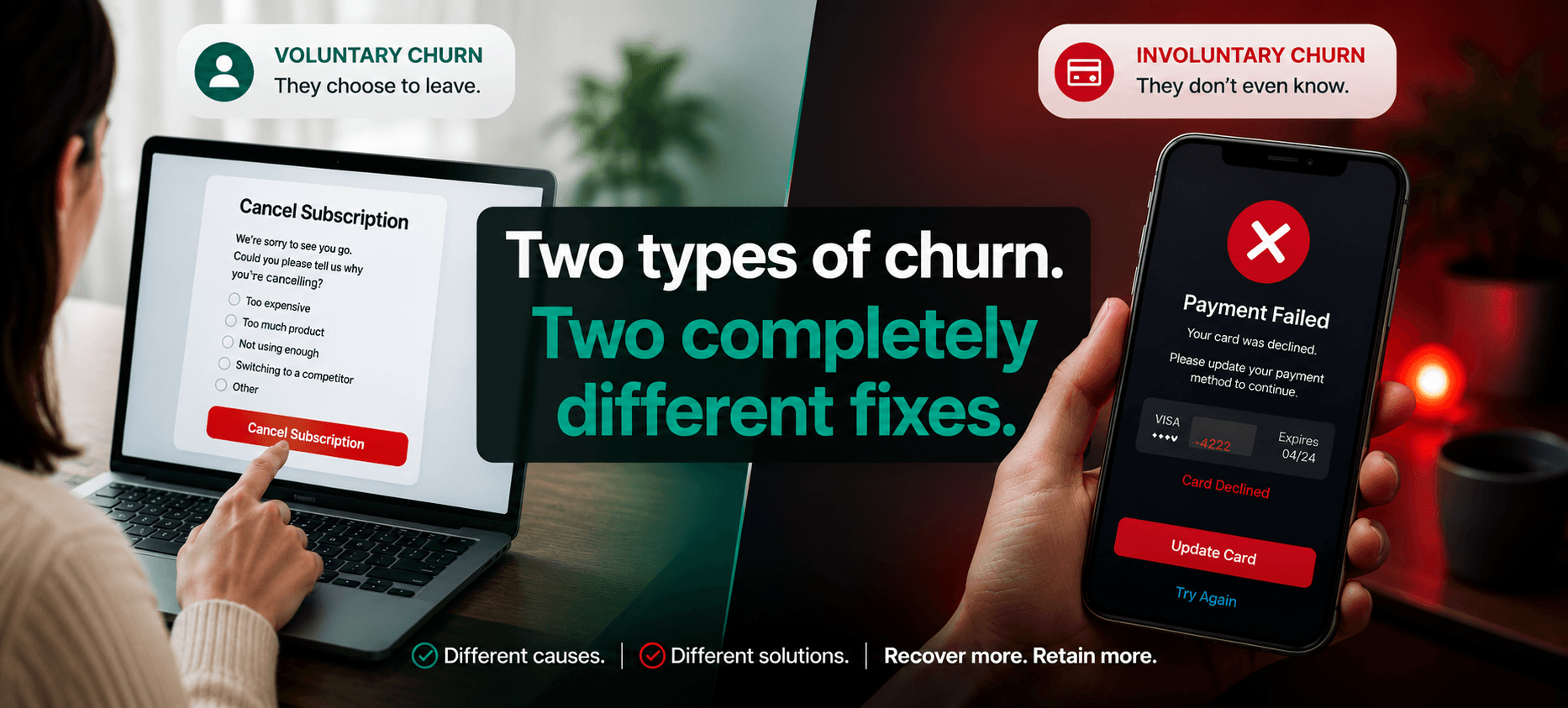
Most subscription brands spend the bulk of their retention budget fighting voluntary churn, customers who actively decide to leave. A cancellation feels like a verdict. Like the customer rejected you.
But there’s another kind of churn happening in the background, quietly, every billing cycle. One that never gets a cancellation-reason survey, never triggers a retention campaign, and never even registers as a “lost customer” in most dashboards until it’s too late.
It’s called involuntary churn, and it’s the single most recoverable revenue leak in any subscription business. These are not customers who wanted to leave. They’re customers whose card expired, whose bank blocked the charge, or whose spending limit reset at the wrong moment. They still want your product. And unless you have the right systems in place, they disappear silently and most never come back.
The good news: because these subscribers never made a conscious decision to leave, they are the most recoverable segment of churn in your entire subscriber base, if the response is fast, specific, and matched to what actually went wrong.
For a full breakdown of how voluntary and involuntary churn differ and the complete retention strategy that addresses both, read our Complete Guide to Revenue Retention & Recovery for Subscription Brands.
What Involuntary Churn Actually Looks Like
Involuntary churn happens when a subscription billing attempt fails, and the customer is removed from the subscriber base, not because they chose to leave, but because the payment infrastructure couldn’t complete the transaction.
Understanding the anatomy of a failed payment is the starting point. Not all failures are alike. The gap between platforms that treat them as identical and those that respond differently to each is where most of the recoverable revenue lives.
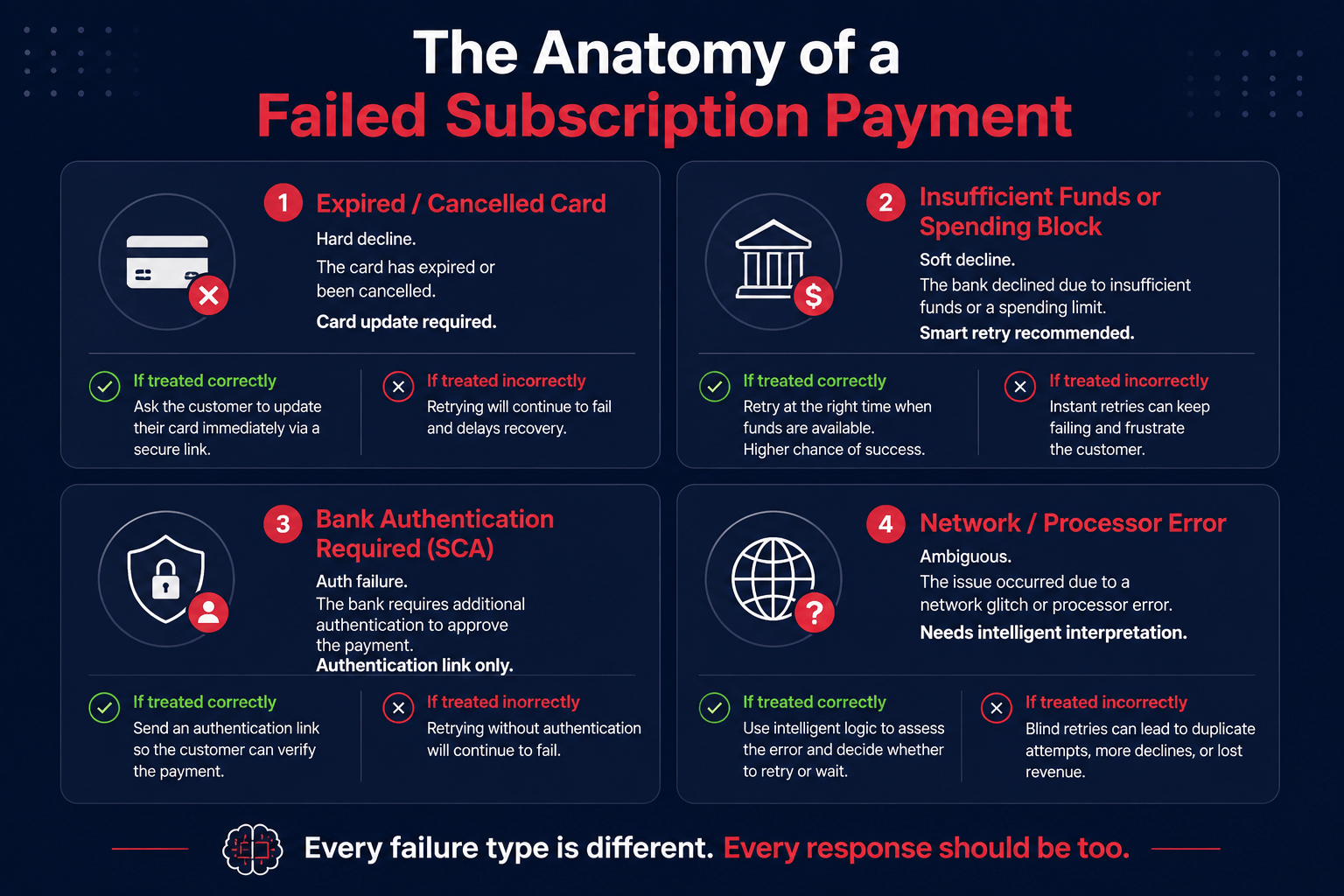
The five most common involuntary churn triggers:
- Expired cards — the most predictable failure type, yet still one of the most common causes of billing loss every single cycle
- Insufficient funds — temporary and entirely recoverable — but only if the retry happens at the right moment
- Velocity and spending blocks — banks flagging charges based on the timing or frequency of how they’re submitted
- Hard declines — card reported lost, stolen, or cancelled; no retry will succeed until the customer provides a new payment method
- Authentication failures — increasingly common as banks in many markets require customer verification before processing recurring charges
Each of these situations is different. And the right response to each one is different too. The problem is that most platforms don’t know the difference — and treat all of them exactly the same.
The Real Cost Is Bigger Than One Missed Payment
When a subscriber churns involuntarily, you’re not just losing one month’s billing amount. You’re losing everything that the subscriber would have paid for the rest of their lifetime with you. And because involuntary churners never made a decision to leave, the relationship is intact, meaning the cost of winning them back is far lower than acquiring a new subscriber.
Studies from subscription billing and payment platforms continue to show that a significant share of failed subscription payments are recoverable when recovery efforts are tailored to the underlying payment issue.
Think about what that means for your business. If a large percentage of failed payments are recoverable and you’re currently recovering fewer than half, which is where most brands without dedicated recovery tooling sit, you’re leaving a significant, predictable, and permanent revenue gap in your business every single month.
And the compounding effect matters. A subscriber who stays another 6 months generates more LTV growth than any marketing campaign you can run at the equivalent cost. Recovering involuntary churn is the highest-ROI retention action available to any subscription brand.
Why Most Platforms Fall Short
The standard dunning approach to failed payments looks something like this:
- Payment fails
- Platform sends a templated “please update your card” email
- Platform retries on day 3, day 7, day 14
- If no resolution: subscription is cancelled
This model has two fundamental problems.
First, it treats every payment failure identically. Not every failure is the same, and responding to all of them in the same way wastes recovery attempts, frustrates customers, and — in some cases — can actually work against you with payment networks.
Second, it has no intelligence about the customer on the other end. A subscriber who has been with you for three years, spends $200 a month, and opens every email you send should not get the same recovery treatment as a subscriber who signed up last month and has never opened a single email. One relationship warrants urgency. The other warrants a lighter touch.
Standard dunning is static. Keeping subscribers requires something fundamentally different.
How enComm’s AI Engine Fixes This, Silently, in the Background
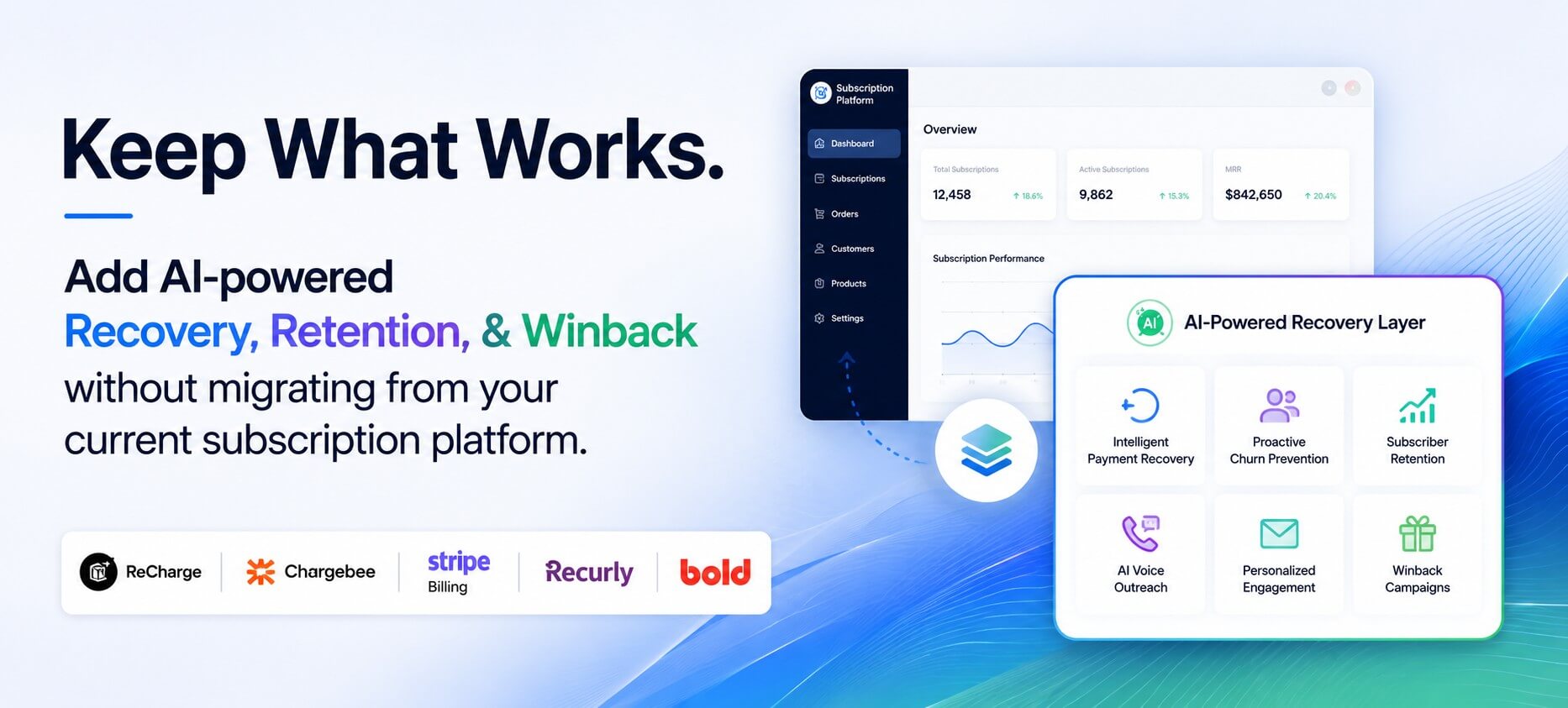
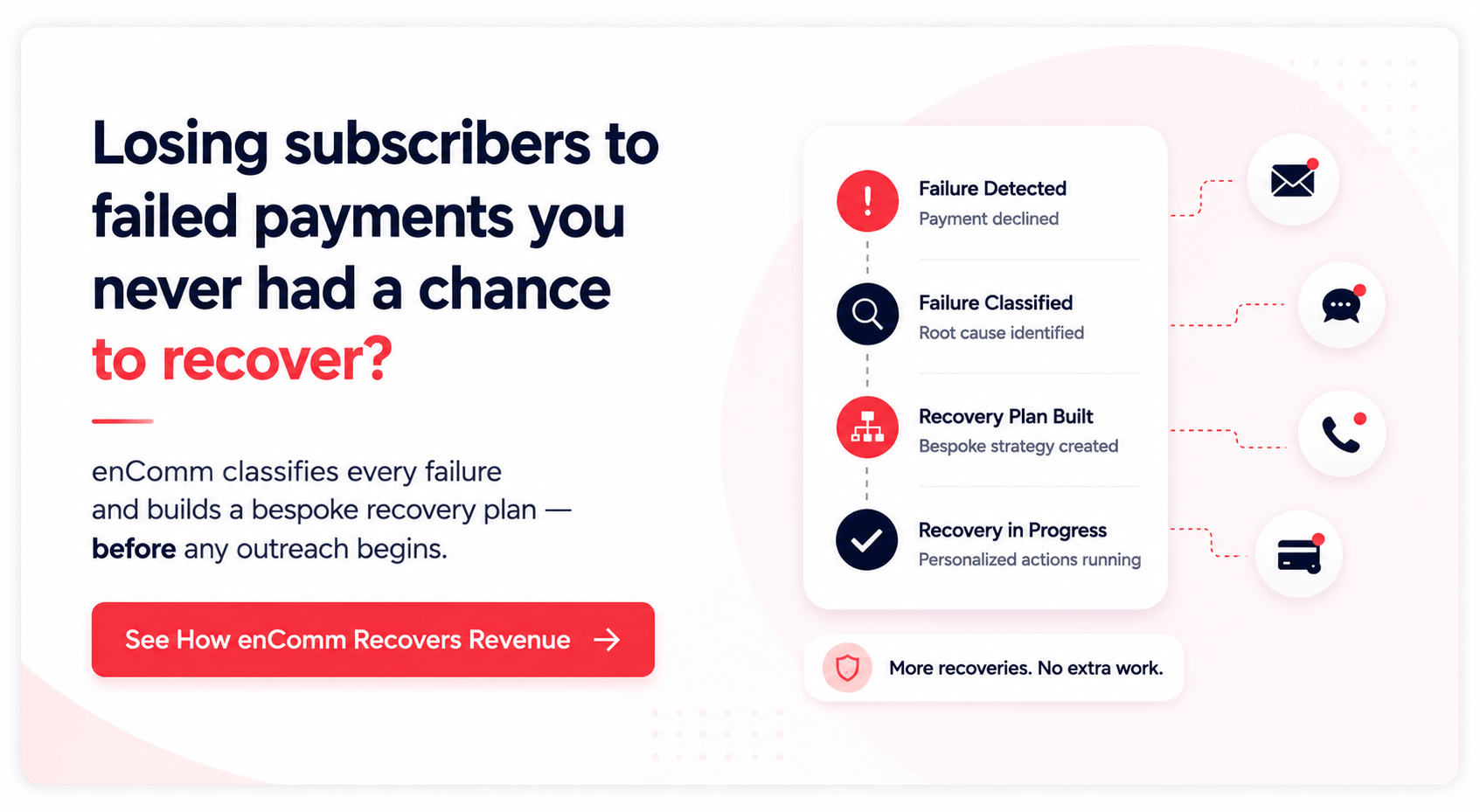
enComm operates on a different philosophy entirely: no two subscribers are the same, no two payment failures are the same, and the response to each one shouldn’t be either. enComm is available to brands on Shopify, ReCharge, Stripe Billing, Chargebee, Recurly, and other subscription platforms as a complete subscription platform on Shopify and as a recovery and retention layer that sits on top of existing subscription stacks on all other platforms.
enComm automatically adapts the recovery experience based on the payment issue and subscriber context, ensuring customers receive the most relevant path to resolution. A customer whose issue has been resolved stops hearing from the system immediately. No redundant follow-ups after the problem is already fixed.
Precision Recovery, Not Spray and Pray
Subscribers receive relevant, timely communication that respects their relationship with your brand. Merchants see a recovery system that acts with urgency where it’s warranted and with restraint where it isn’t.
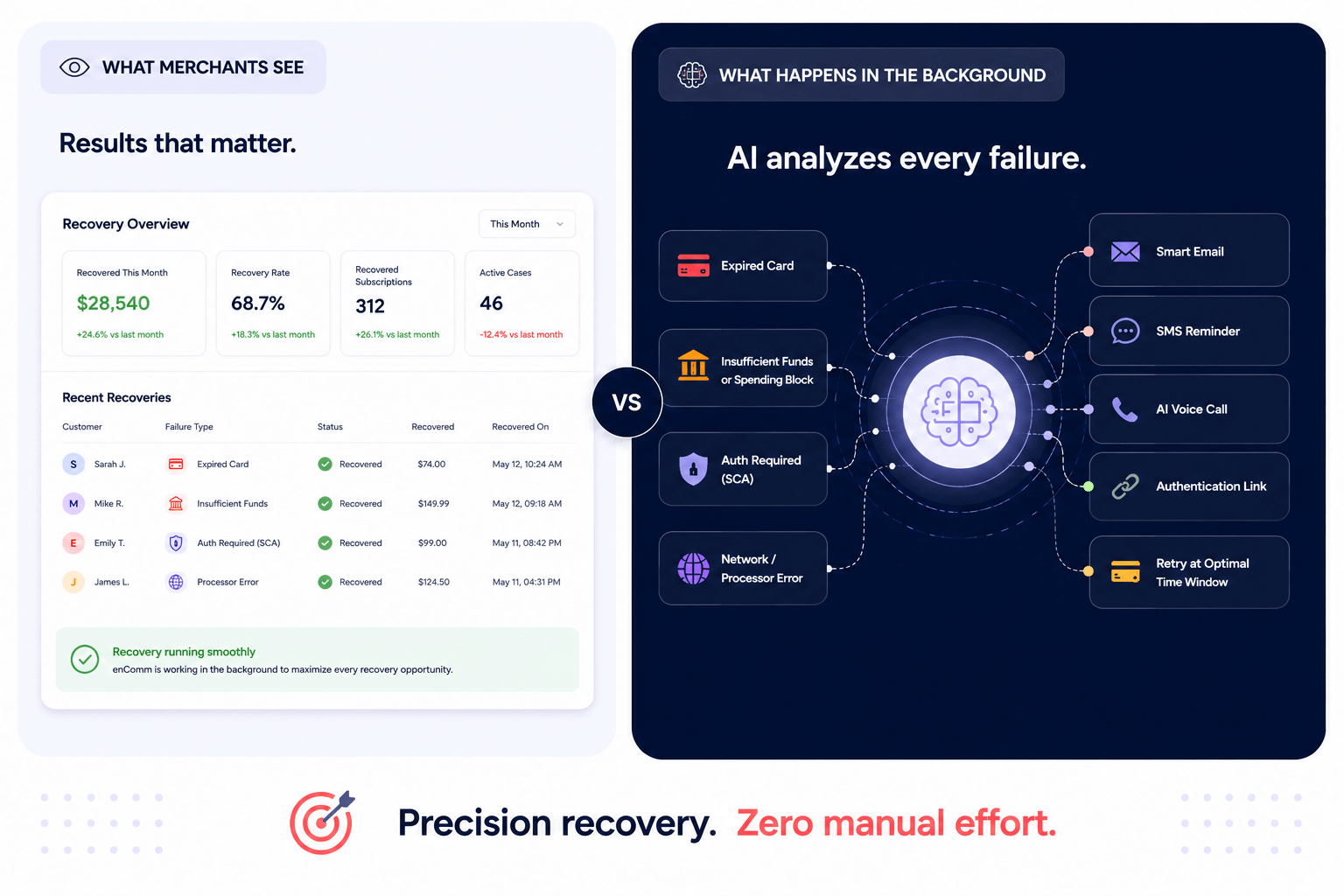
For cases where written outreach hasn’t resolved the issue, enComm can initiate a genuine AI voice conversation with the customer, one that’s fully informed by their history and the specifics of their situation, and that can resolve the issue or offer a retention alternative on the spot. This is not a robocall. It’s a real conversation, placed only when appropriate, within the hours you configure.
Every action the system takes is logged and visible. You can see what happened, when it happened, and what the outcome was, without having to manage any of it yourself.
The Recovery Experience Your Subscribers Actually See
Every recovery email, SMS, and Voice call has one goal: get the subscriber to take action. The surface where that action happens is the recovery page. Most subscription platforms don’t have a branded recovery page. They redirect subscribers to a generic Shopify payment page, a plain card form, or a Klaviyo flow with no merchant branding in sight.
enComm’s branded recovery page is fully customised to the merchant. The subscriber sees the merchant’s logo, their brand colour, and their display name, hosted on the merchant’s own domain, so the subscriber never sees an unknown URL. Setup takes seconds: branding is auto-populated from the merchant’s store URL at onboarding. Most merchants need to change nothing.
The page adapts its content to the specific failure. It never shows a generic card prompt that would confuse and frustrate the subscriber.
When the subscriber acts by updating their card, completing authentication, or accepting a retention offer, the recovery case closes immediately, all remaining outreach steps cancel, and a confirmation lands in their inbox under the merchant’s brand. The subscriber has no indication that a third-party tool was ever involved.
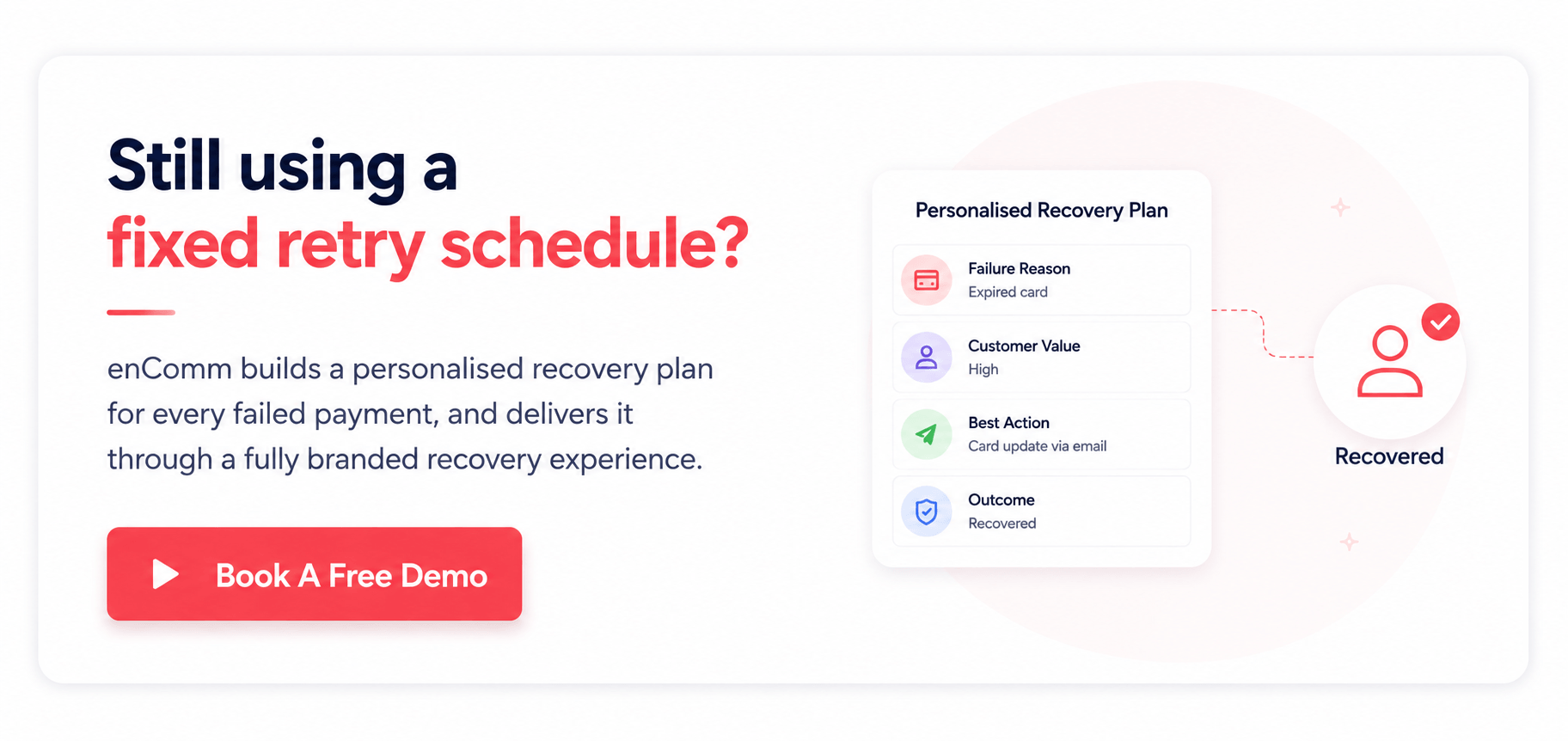
Proactive Retention: Stopping the Slide Before It Starts
Payment recovery handles the crisis. But enComm’s retention layer is the net you put up before anyone falls.
Most subscription platforms are reactive. They notice a customer has cancelled and then try to respond. By that point, the customer has already made their decision, and the odds of reversing it drop dramatically.
enComm works earlier. The platform continuously monitors subscriber behaviour across your entire active subscriber base, surfacing early signals that a customer is drifting before they’ve consciously decided to leave. When those signals appear, enComm acts, reaching out with personalised messaging or a targeted offer at the moment when it’s most likely to land.
This means the retention conversation happens while the customer still feels positively about your brand. Not after frustration has set in. Not after they’ve already clicked cancel.
When a Customer Does Try to Cancel
Even with proactive intervention, some subscribers will still initiate a cancellation. When they do, enComm doesn’t step aside. It intercepts the moment and turns it into a retention opportunity.
Rather than a generic “are you sure?” prompt, the customer is met with a response that’s relevant to why they’re leaving. The offer they see, whether that’s financial relief, a break from their subscription, a reduced frequency, or a different product entirely, is matched to their stated reason. Subscribers are presented with relevant retention options based on their situation, helping merchants save more relationships without creating friction.
Merchants retain full control over what can and can’t be offered. Every discount limit, every available offer type, and every guardrail can be configured. The intelligence is enComm’s, but the parameters are yours.
The Business Case in Plain Numbers
Industry data shows that companies using intelligent, AI-driven payment recovery tools save 20–40% of the revenue they would have otherwise lost to churn.
Modern recovery systems significantly improve recovery performance by combining intelligent retries, adaptive recovery workflows, and proactive personalized customer outreach. Recurly’s enterprise recovery analysis found that optimized retry strategies improved failed payment recovery rates from approximately 53% to 71% without replacing existing billing infrastructure.
Stripe also highlights that recovery timing and retry intelligence improve payment recovery outcomes.
Research increasingly shows that personalised engagement plays an important role in customer retention. According to Zendesk's 2025 CX Trends Report, organisations leading in AI-powered customer experience achieve 22% higher customer retention rates, while 61% of consumers expect interactions to feel personalised. As subscriber expectations continue to evolve, delivering the right message through the right channel at the right time has become a key component of long-term customer loyalty.
Put that in context: if your store processes $50,000 in monthly recurring revenue and you’re currently recovering around 30% of failed payments with basic dunning, improving recovery rates to 60–70% using modern recovery systems can create a meaningful, compounding lift in recurring revenue month after month, without changing your product, pricing, or marketing strategy.
Involuntary churn is, by definition, the most recoverable form of revenue loss in your business. Whether you're using Shopify Subscriptions, ReCharge, Stripe Billing, Chargebee, Recurly, or any other platform, involuntary churn remains one of the largest sources of preventable revenue loss. These are customers who still want to be subscribers. They just hit a friction point at exactly the wrong moment. With an intelligent system like enComm working in the background (continuously, automatically, for every subscriber), most of them can be brought back without any manual effort on your part.
Involuntary churn is one piece of the retention picture. For the complete framework covering proactive churn prevention, winback campaigns, and maximising subscriber lifetime value, read the Complete Guide to Revenue Retention & Recovery.