Already on ReCharge or Chargebee? Here’s What AI-Powered Recovery Adds
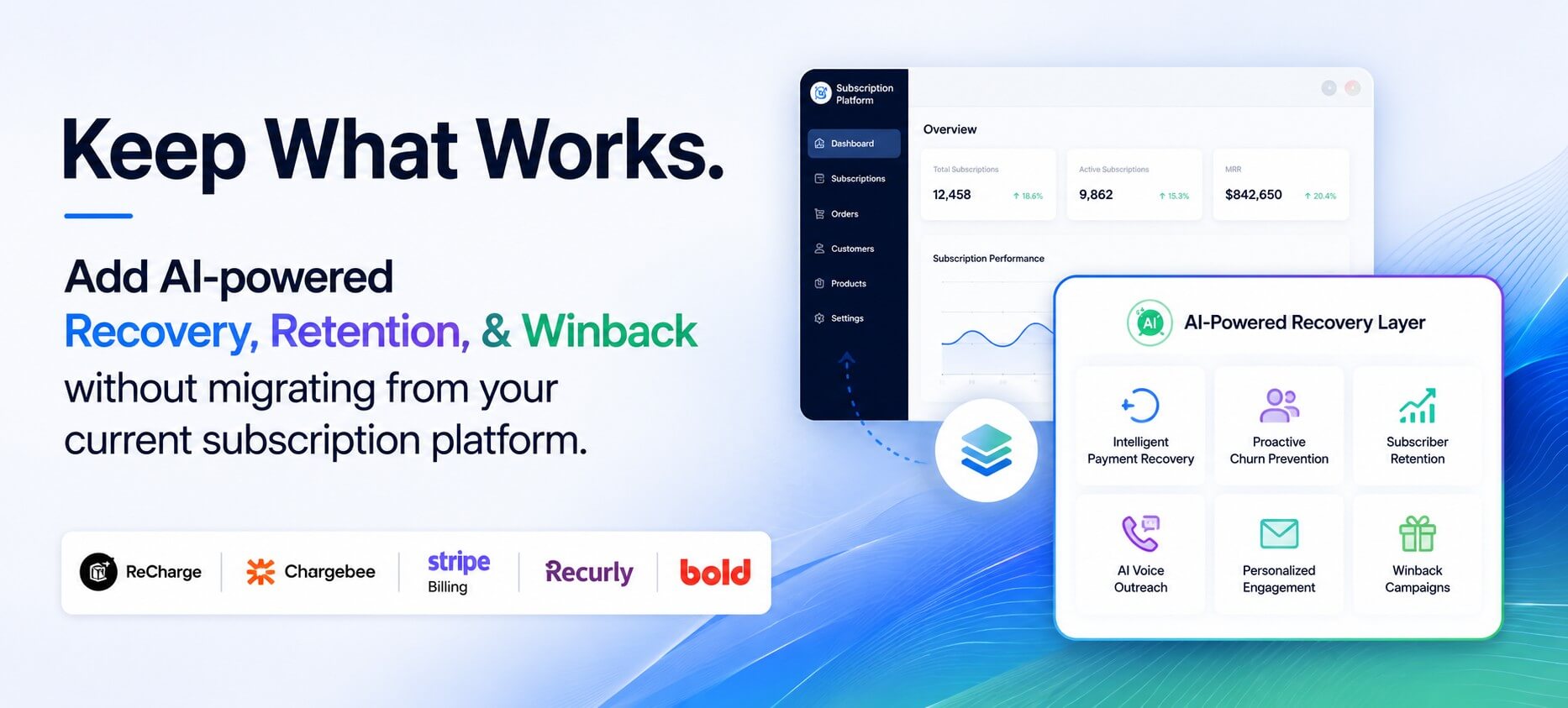
You don’t have to rip out your subscription stack to fix your recovery problem. Here’s what changes when an AI-powered recovery layer sits on top of the platform you already use.
If you’re running your subscription business on ReCharge, Chargebee, Stripe Billing, Recurly, or Bold, you probably didn’t choose that platform by accident. It handles your billing intervals, selling plans, and checkout, and it’s deeply wired into your operations. Migrating off it isn’t a weekend project; it’s months of testing and the real risk of disrupting active subscribers mid-cycle.
So when “AI-powered recovery” comes up, the reasonable reaction is: does that mean another migration? It doesn’t have to.
There’s a meaningful difference between subscription management (billing, selling plans, contracts) and revenue recovery (what happens when a payment fails, a subscriber tries to cancel, or someone goes quiet after a card expires). Most platforms are built for the first job. Few are built for the second with any real intelligence behind it. This post is for merchants happy with their subscription platform who want to know what an AI-powered recovery layer adds, without touching what’s already working.
Related reading: Why 30–40% of Your Subscriber Churn Is Actually Involuntary is a useful starting point. It explains why failed payments are often the biggest hidden revenue leak, regardless of which platform you’re on.
Key Takeaway
Subscription platforms like ReCharge, Chargebee, Stripe Billing, Recurly, and Bold are designed to manage subscriptions. enComm’s AI-powered recovery adds intelligence around failed payments, churn prevention, and subscriber retention without requiring a platform migration.
The Gap Most Subscription Platforms Leave Open
Most subscription platforms are genuinely good at what they’re built for: managing recurring billing, selling plans, and charging on schedule. What they’re typically not built for is treating every failed payment as a unique situation needing its own response.
The standard approach looks like this: a payment fails, the system retries it a fixed number of times on a fixed schedule, and sends a templated “please update your payment method” email. If nothing works, the subscription is canceled.
The problem is that a fixed retry schedule treats a temporarily declined card the same as one that’s permanently dead, treats a two-year subscriber the same as someone on their first cycle, and sends the same email regardless of why the payment actually failed. This is the gap an AI-powered recovery layer closes without requiring any change to how subscriptions are billed, managed, or fulfilled.
Why Billing Success and Recovery Are Different Problems
One reason recovery often gets overlooked is that subscription platforms and recovery systems are judged by completely different outcomes.
A subscription platform is successful when recurring orders are processed accurately, subscription changes are handled correctly, and billing operations run without disruption. Its focus is operational reliability.
Recovery success, however, is measured by outcomes that happen after something goes wrong. How much failed revenue is recovered? How many subscribers stay active after a payment issue? How many cancellations are prevented? How much customer lifetime value is preserved?
This distinction matters because a subscription business can have an excellent billing setup and still lose significant recurring revenue through avoidable churn. A payment failure may represent a temporary problem rather than a lost customer, but recovering that revenue often requires a different set of tools and engagement strategies than those used to manage subscriptions day to day.
What an AI-Powered Recovery Layer Actually Adds
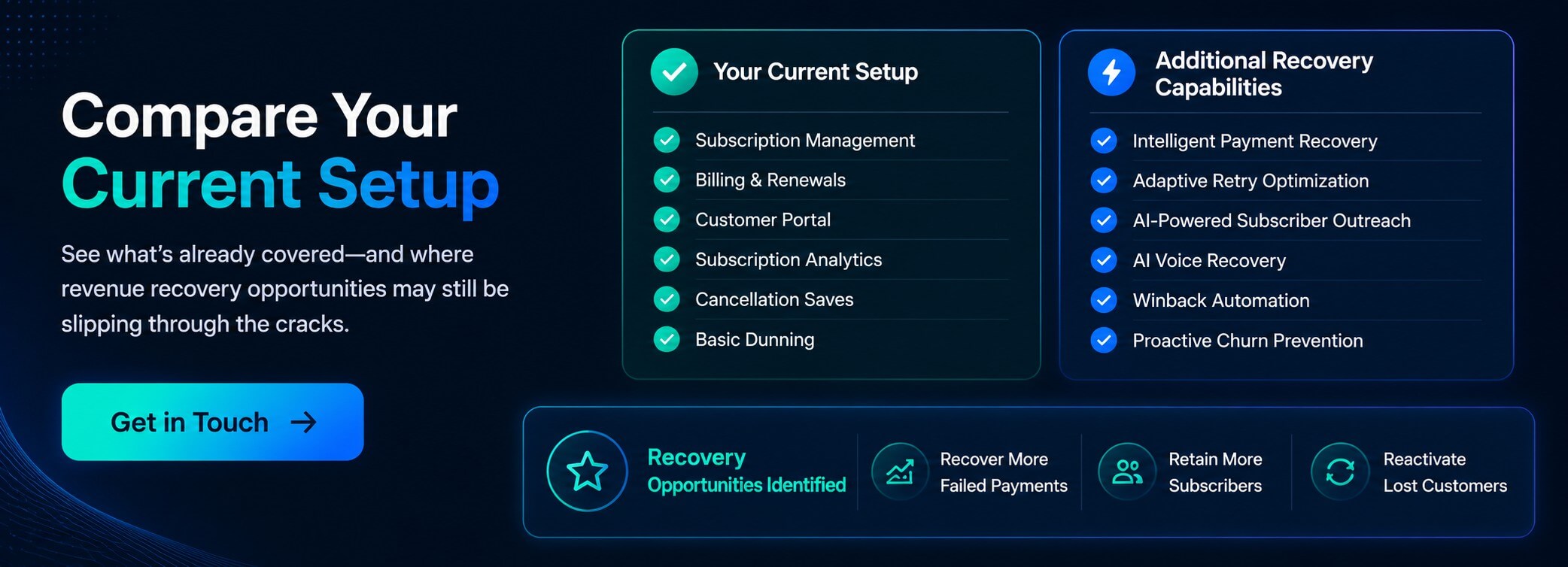
At a high level, the layer adds six things your current dunning setup almost certainly doesn’t have:
- Failure classification — every failed payment is read and categorised as a soft decline, hard decline, or authentication-required case before any retry or outreach happens.
- Per-customer recovery plans — the approach taken (how fast, through which channels, how persistent) is shaped by the individual customer’s value, tenure, and engagement history, not a single sequence applied to everyone.
- Smart retry timing — retry attempts are optimized using payment context and customer signals rather than fixed schedules.
- AI-written outreach — emails and SMS are generated per case, not pulled from a template with a name dropped in.
- AI outbound voice calls — a channel most dunning systems simply don’t have are used when email and SMS haven’t resolved the issue.
- A branded recovery page — automatically styled with your logo and colours, hostable on your own domain, so customers never see a third-party tool.
We’ve covered exactly how this sequence runs (classification, plan-building, retry timing, channel selection, and adaptive responses) in detail in the blog, 85% of Failed Payments Are Recoverable — Here Is the Recovery Sequence That Gets Them Back.
Subscription Platform | Recovery Layer |
Manages billing | Recovers revenue |
Creates selling plans | Prevents involuntary churn |
Processes renewals | Improves renewal success |
Stores subscription data | Activates recovery actions |

How This Works on Top of ReCharge, Chargebee, Stripe Billing, Recurly, and Bold
For merchants on other subscription platforms, enComm’s recovery layer sits alongside it, watching for payment failures and executing the recovery and winback actions that actually move the needle.
Here’s the practical split between what your platform handles and what the recovery layer adds on top:
| Your subscription platform | + Encomm recovery layer | |
| Billing schedules, selling plans, contracts | ✓ Core function | No change — stays exactly as is |
| Payment retry on failure | Fixed schedule (e.g., retry every few days) | AI-classified, smart-timed retries based on failure sub-type and customer history |
| Card update requests | Generic templated email | AI-written, case-specific email + SMS + branded recovery page |
| Discount, pause, skip, or product swap as a recovery action | Available as manual actions in most platforms | Triggered automatically as part of a recovery plan, matched to the failure and the customer |
| Outbound phone recovery | Not available | AI voice calls with full case context to resolve issues in real time. |
| Recovery page branding | Often redirects to a generic platform payment page | Auto-branded from your store, hostable on your own domain |
| Post-cancellation winback | Limited or manual | Automated campaigns matched to why the subscription was lost |
Retry, card update, discount, pause, skip, and product swap are all actions that exist as capabilities across ReCharge, Chargebee, Stripe Billing, and Recurly, but in most setups, triggering them intelligently, in the right combination, at the right moment, is a manual or semi-manual process. The recovery layer is what decides when and how those actions get used for a given case, then executes them through your existing platform.

Setup itself is designed to be low-effort: when you connect your platform, your customer, subscription, and product data gets imported automatically. There’s no CSV export, no manual data entry, and no need to rebuild anything you’ve already configured.
For winback specifically (recovering subscribers after a cancellation) the same logic applies. A cancellation tied to a failed payment gets a different winback approach than a voluntary cancellation, and the campaign is matched to the situation rather than treated as one generic “we miss you” sequence.
What If You’re on Loop, Skio, or Stay.ai?
If your subscriptions run through a Shopify-native app like Loop, Skio, or Stay.ai, the relationship to a recovery layer looks a little different; these platforms already build in some level of cancellation flow or retry logic of their own. The question isn’t “do these platforms do anything for retention & recovery” (because they do); it’s whether what they do goes as deep as it could.
Here’s how the category generally breaks down on a few specific capabilities:
Capability | Loop | Skio | Stay.ai | + Encomm |
Failed payment classification | ML-based retry timing | Behavioral retry logic | AI-driven retry optimization | AI-driven failure classification to guide the recovery response. |
Smart retry timing | ML-optimized, up to 15 attempts | Behavioral — best day/hour | AI-optimized | AI-driven retry timing informed by payment context and customer signals. |
Outreach copy | Template-based | Template-based | Template-based | Generated per case, per subscriber |
AI outbound voice calling | Not available | Not available | Not available | AI voice outreach to resolve payment issues & apply retention offers in real time. |
Cancellation save flow | Multi-step with video/GIF | Multi-step (pause/skip/swap/discount) | AI-personalized | Two-round negotiation, calibrated to customer LTV, without repeating a declined offer |
Proactive churn risk scoring | Not available | Not available | ML-based predictive scoring | AI-driven churn risk scoring informed by subscriber engagement and account activity. |
Winback campaigns | ✓ — revives expired and paused subscriptions | ✓ | ✓ | ✓ — matched to the specific cancellation reason, with Multi-channel winback campaigns that include AI call outreach. |
Shared context across systems | Not connected | Not connected | Partially connected | Shared subscriber context across recovery, retention, and winback workflows. |
The pattern across all three platforms is similar: there’s some retention logic, but it tends to live in one part of the lifecycle (usually the cancellation flow), while payment recovery, the area where the 70–85% recovery opportunity actually sits, gets comparatively basic treatment, and the systems generally don’t talk to each other.
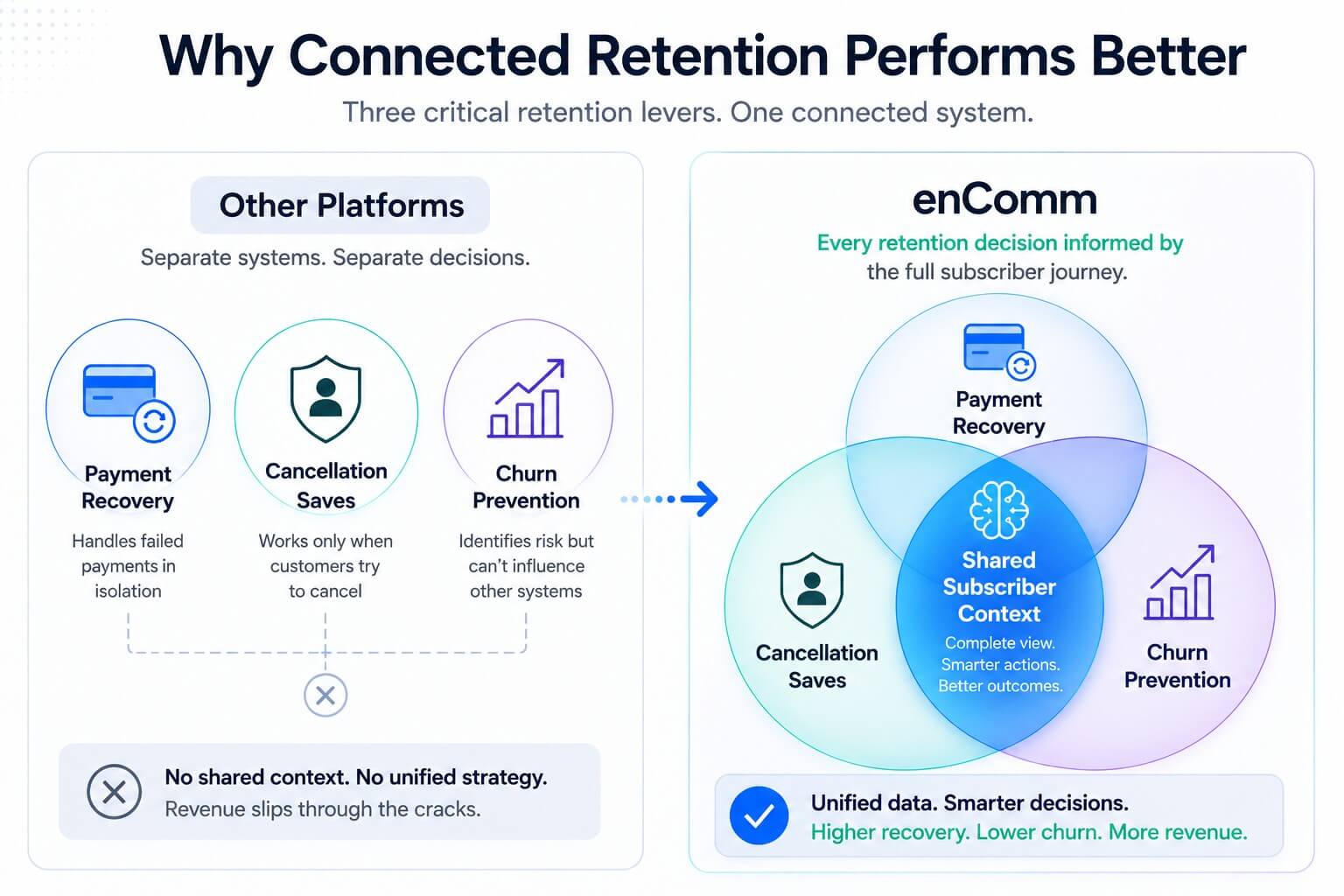
The honest framing here is that the closer your stack already sits to Shopify’s native subscription infrastructure, the more directly a deeper recovery and retention layer can plug in but because every merchant’s configuration of Loop, Skio, or Stay.ai is a little different (custom flows, third-party integrations, store-specific setups), the specifics are worth a direct conversation rather than a blanket claim.
Why Brands Add This Layer Instead of Switching Platforms
The honest pitch here isn’t “replace your platform.” It’s “your platform is good at billing — let something built specifically for recovery and retention handle that part.” The cost of not doing this compounds: 2025 payment industry benchmarks from The Kaplan Group show best-in-class recovery systems recover 70–85% of failed payments, against an industry median closer to 47% — a gap that’s almost entirely down to how intelligently recovery is run, not the billing platform underneath. Recurly’s 2026 State of Subscriptions report, based on data from 76 million subscribers, found the software industry alone recovered over $155 million through payment recovery tooling in 2025 — revenue sitting on top of whatever billing platform a merchant already uses.
For a complete view of how retention and recovery work together across the full subscriber lifecycle — from proactive churn prevention through to post-cancellation winback — the Complete Guide to Subscription Revenue Retention and Recovery is the place to start. And if you want to understand how reducing the number of separate tools a subscription brand runs fits into this, How AI Orchestration Replaces 5 Separate Shopify Apps for Subscription Brands covers that angle.

If You Ever Do Want to Consolidate
For Shopify brands considering, down the line, bringing subscription management and recovery under one roof — that option exists too. Encomm’s subscription management is built natively on Shopify’s own subscription infrastructure, with zero transaction fees on subscription orders, on every plan, forever. And because the recovery layer already imports your customer, subscription, and product data automatically at setup, moving to the full platform later doesn’t mean starting from scratch or disrupting subscribers mid-cycle. It’s not a prerequisite for the recovery benefits today, just an option worth keeping in the back pocket.
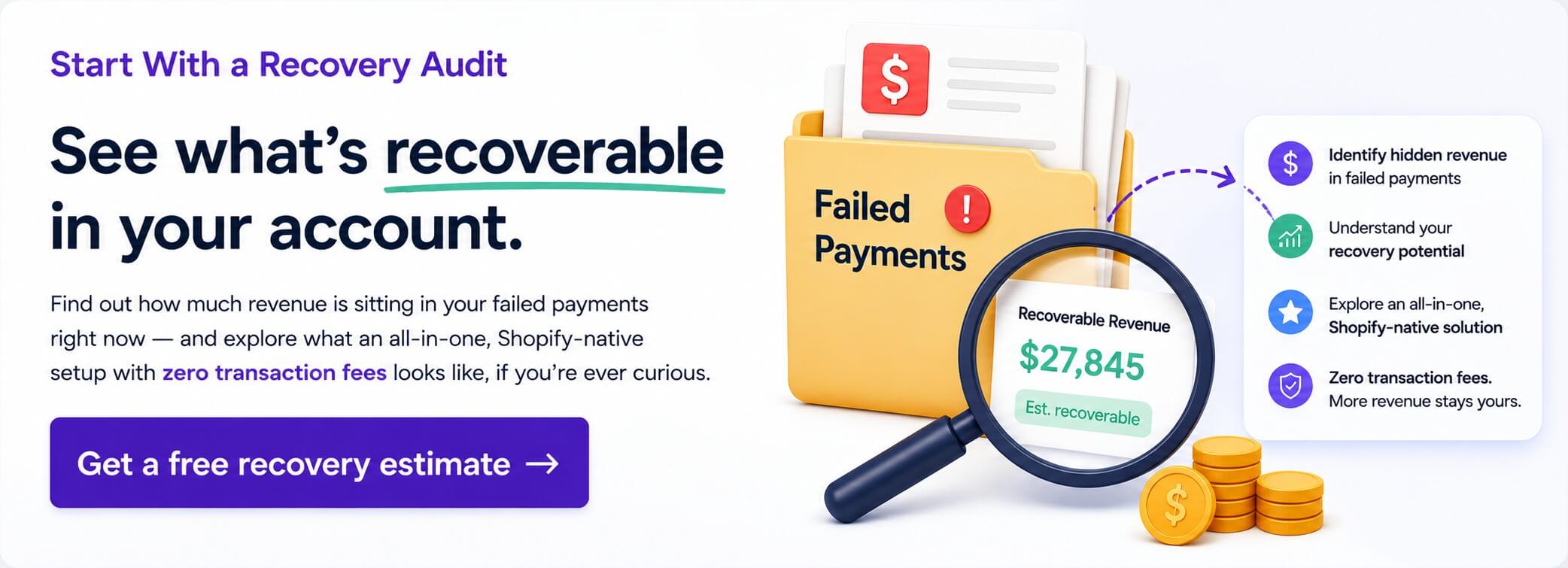
If you’re on ReCharge, Chargebee, Stripe Billing, Recurly, or Bold and your platform works fine for billing, there’s no reason to disrupt that. What’s missing isn’t a billing capability; it’s a layer that classifies every failed payment correctly, builds a recovery approach suited to each customer, times retries intelligently, writes outreach that doesn’t read like a template, and picks up the phone when email and SMS don’t land.
Frequently Asked Questions About AI Voice Payment Recovery
No. An AI-powered recovery layer is designed to sit on top of your existing subscription platform. Your platform continues managing billing schedules, selling plans, and contracts exactly as it does today. The recovery layer focuses specifically on what happens when a payment fails or a subscriber is at risk of churning.
No. It works alongside your existing subscription platform, adding payment recovery, retention, and winback capabilities without replacing billing infrastructure.
Recovery layers of this kind are built to work with platforms including ReCharge, Stripe Billing, Chargebee, Recurly, and Bold Subscriptions, among others. The level of integration can vary by platform, so it’s worth confirming specifics for your setup.
No. Recovery pages can be fully branded with your logo, colours, and store name, automatically pulled from your store at setup, and hosted on your own domain. Customers see your brand throughout.
Your customer, subscription, and product data are typically imported automatically at setup. There’s no manual CSV export or data entry required.
Most built-in dunning is a fixed retry schedule with a templated email. An AI-powered layer classifies each failure type first (soft decline vs. hard decline vs. authentication required), builds a recovery approach suited to the individual customer, times retries based on multiple signals rather than a fixed interval, and generates outreach copy specific to that case — plus adds channels like AI voice calling that most built-in dunning doesn’t have at all.
The gap between an “okay” recovery rate and a strong one is often larger than merchants expect. Industry data shows a meaningful difference between median recovery rates (around 47%) and best-in-class rates (70–85%) and that gap is almost entirely a function of how intelligently the recovery process runs, not the billing platform underneath it.
These platforms generally include some retention logic, often a cancellation save flow, but payment recovery and cross-system context (where payment recovery, churn scoring, and cancellation saves share information) tend to be the gaps. The specifics depend on your configuration, so it’s worth a direct conversation.
Yes, for Shopify merchants, an all-in-one option exists with subscription management built natively on Shopify’s own infrastructure, including zero transaction fees on subscription orders. This isn’t required to benefit from the recovery layer, but it’s an option if you’re ever looking to consolidate.