Why AI Voice Agents Are the Most Effective Layer in Subscription Payment Recovery
For years, subscription brands have treated failed payments as an unavoidable cost of doing business.
A renewal fails. An automated email is sent. Another reminder follows a few days later. Sometimes a support agent reaches out to high-value subscribers. Some customers eventually update their payment details. Many don’t.
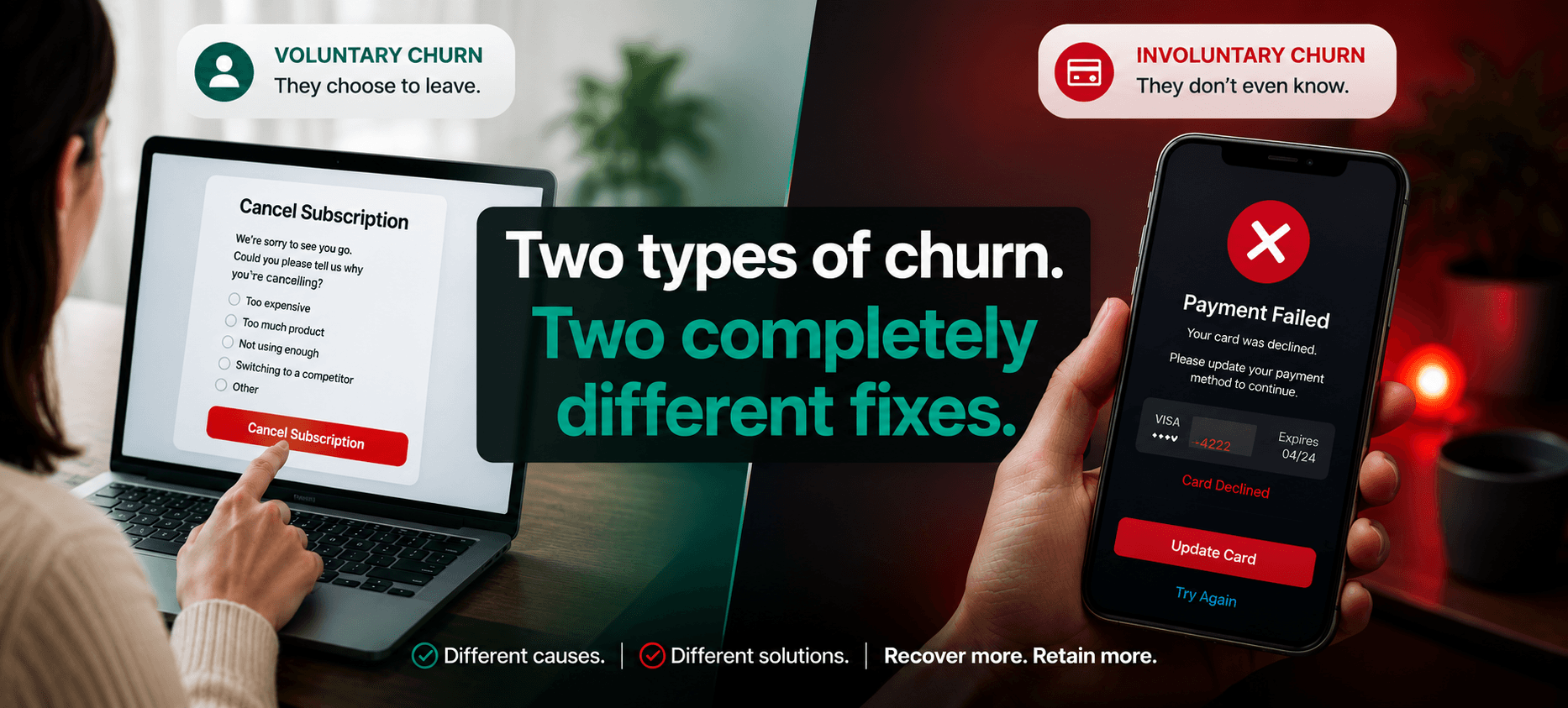
The problem is that most subscription businesses still approach payment recovery as a notification challenge when it is actually a response-time challenge. In fact, failed payments remain one of the largest causes of involuntary churn for subscription brands. We explore the financial impact in greater detail in our guide on involuntary churn and failed payment recovery.
The gap between a failed payment and a successful recovery is where recurring revenue begins to leak. The longer that issue remains unresolved, the greater the risk that a subscriber abandons the service altogether. What starts as an expired card or a temporary payment issue can quickly lead to cancelled subscriptions, interrupted shipments, lost customer lifetime value, and additional acquisition costs to replace that customer.
As subscription markets mature and customer acquisition costs continue to rise, brands are placing greater emphasis on protecting existing revenue rather than simply acquiring more subscribers. That shift is forcing companies to rethink a critical question:
How do you engage subscribers quickly enough to resolve failed payments before they churn?
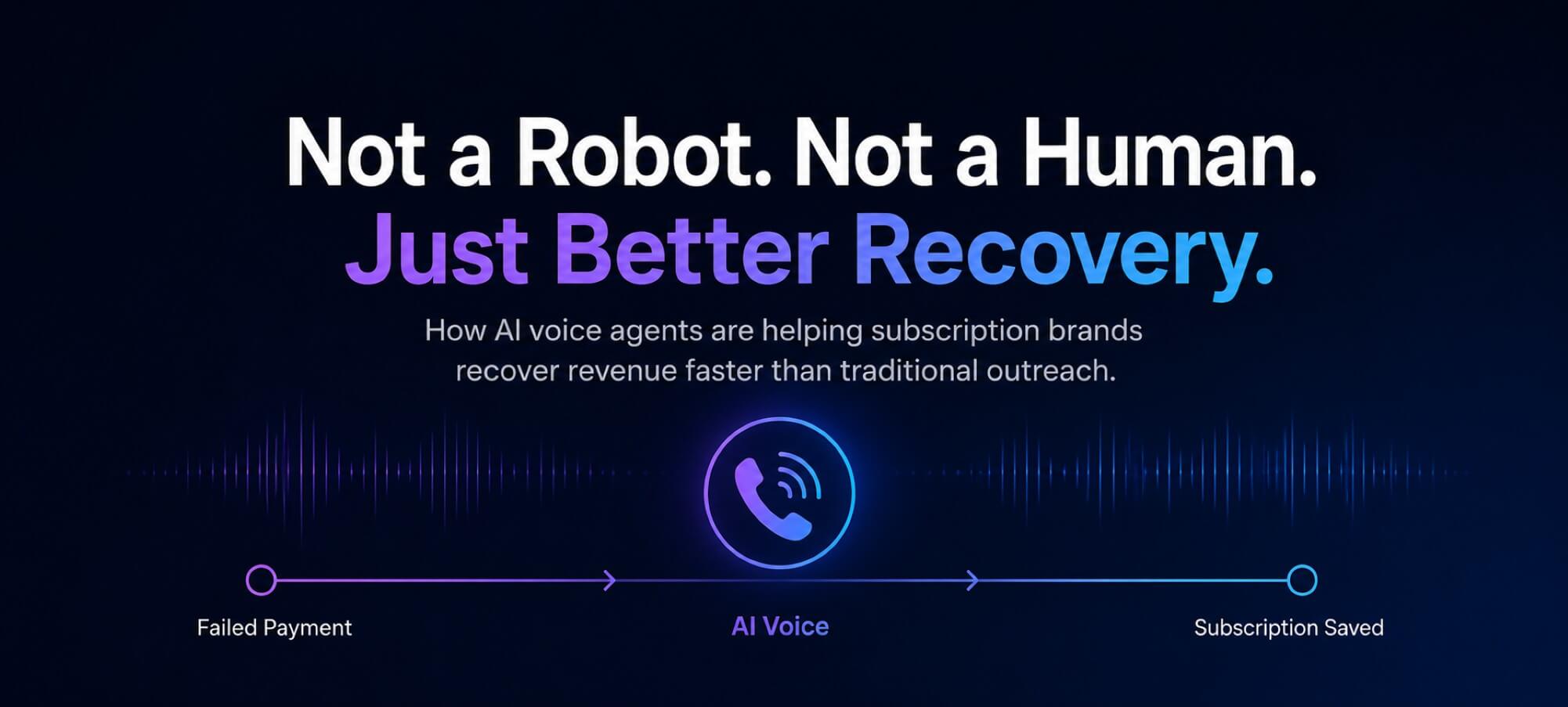
Increasingly, the answer is not another email sequence or a larger recovery team. It is a new category of customer engagement that sits between traditional automation and human outreach: AI voice agents.
Key Takeaway
AI voice agents outperform traditional payment recovery workflows because they create real-time, two-way conversations that help subscribers resolve failed payments faster. Compared with manual outreach, they provide consistent engagement, 24/7 availability, and significantly lower operating costs, making them one of the most effective tools for reducing involuntary churn and protecting recurring revenue.
Why Traditional Dunning Workflows Are Losing Effectiveness
Email-based recovery workflows still dominate subscription commerce, but their effectiveness has started to plateau.
The issue is not that email no longer works at all. The issue is that modern customers are overwhelmed by notifications, promotions, authentication alerts, shipping updates, and marketing campaigns competing for attention simultaneously.
A failed payment email today is competing against dozens of other messages inside crowded inboxes. Even if the customer sees the message, recovery still depends on multiple actions happening in sequence:
- Opening the email
- Reading the explanation
- Clicking the recovery link
- Logging into the account
- Updating payment details
- Completing authentication if required
Every additional step increases drop-off risk. For subscription businesses operating at scale, these delays compound into measurable revenue leakage.
Imagine a subscription brand processing 40,000 recurring billing attempts every month with an average subscriber value of $85. If even 8% of those payments fail initially, that represents $272,000 in potentially recoverable monthly revenue sitting inside recovery workflows. Recovering even an additional 15% to 20% of those failed payments meaningfully changes monthly recurring revenue performance without spending another dollar on customer acquisition.
The challenge is that email recovery is passive by design. It waits for the customer to notice the problem and decide to act.
Voice conversations create immediate engagement instead.
This is one of the reasons AI voice recovery is becoming more attractive to subscription operators. Instead of stretching recovery across multiple emails and delayed retries over several days, payment issues can often be clarified and resolved within a single interaction.
enComm’s AI payment recovery system can proactively engage subscribers, explain payment issues, provide secure payment update links, and guide customers toward resolution while the interaction is still active.
That real-time engagement changes the recovery dynamic entirely.

Customers Care More About Speed Than Whether the Voice Is AI
One of the biggest misconceptions around AI voice agents is that customers automatically reject them because they are not human.
In reality, customer tolerance depends heavily on context.
Customers dislike irrelevant outreach, robotic IVR systems, long wait times, repetitive conversations, and interactions that fail to solve the problem quickly. But subscription payment recovery conversations operate very differently. These are not cold calls. They are account-related conversations tied to an active subscription relationship.
The customer already knows the brand. The payment issue is legitimate. The outcome directly affects their subscription continuity.
In those situations, speed and convenience often matter more than whether the interaction is AI-assisted or human-led.
That behavioral shift is already becoming measurable across customer service environments. According to JestyCRM’s voice agent statistics report, 61% of consumers prefer faster AI responses over waiting for human assistance, while 90% expect immediate responses from businesses.
Those expectations align closely with the realities of subscription recovery.
A subscriber whose payment fails usually does not want a long support conversation. They want immediate clarity:
- Why did the payment fail?
- Is the subscription still active?
- What needs to be updated?
- How quickly can the issue be resolved?
AI voice agents are increasingly optimized for exactly these types of structured, time-sensitive interactions.
This is where older assumptions about AI communication begin to break down. Customers are not necessarily evaluating whether a voice sounds perfectly human. They are evaluating whether the interaction feels useful, informed, and efficient.
That distinction is critical.
Human Recovery Teams Cannot Scale the Way Subscription Businesses Need Them To
Many subscription brands still assume that human outreach automatically leads to better recovery outcomes.
In certain situations, human interaction absolutely matters. Complex escalations, emotionally sensitive support conversations, and enterprise account management still benefit heavily from experienced human teams.
But subscription payment recovery is operationally different. Failed payments occur continuously across time zones, billing cycles, and subscriber segments, making it difficult for manual recovery teams to respond quickly and consistently at scale. As subscriber volumes grow, recovery operations often require additional staffing, training, management oversight, and quality control. AI voice systems remove many of those constraints by providing always-on engagement, consistent communication, and the ability to handle large volumes of recovery interactions simultaneously. The result is not simply lower operating costs but faster subscriber engagement and more predictable recovery outcomes.
Industry research on AI voice operations suggests AI agents can reduce servicing costs from roughly $0.70 per minute to as little as $0.03–$0.04 per minute while significantly improving handling capacity. More importantly, AI systems can operate continuously without queue times, staffing limitations, or inconsistent recovery execution.
This is not simply about reducing costs. It is about creating operational consistency at subscription scale. As AI adoption accelerates across customer-facing operations, organizations are increasingly viewing AI as a productivity multiplier rather than a replacement for employees. According to PwC’s AI Predictions Report, businesses are moving beyond experimentation and focusing on practical AI applications that improve efficiency, customer experience, and operational performance.
That shift is particularly relevant for subscription businesses, where delayed recovery directly impacts retention outcomes.

Why AI Voice Works Better When It Is Connected to Recovery Intelligence
One reason older robocalling systems failed is that they treated every customer interaction identically.
Modern subscription recovery cannot operate that way anymore.
Not every failed payment represents the same risk. Some subscribers simply need to update an expired card. Others require bank authentication. Some are temporarily facing insufficient funds. Others may already be close to cancellation.
The effectiveness of AI voice recovery depends heavily on context awareness.
enComm’s recovery platform approaches failed payments dynamically by adapting recovery engagement based on the payment scenario and subscriber state rather than relying on static retry schedules alone.
That context-driven approach is what makes AI conversations feel practical instead of robotic.
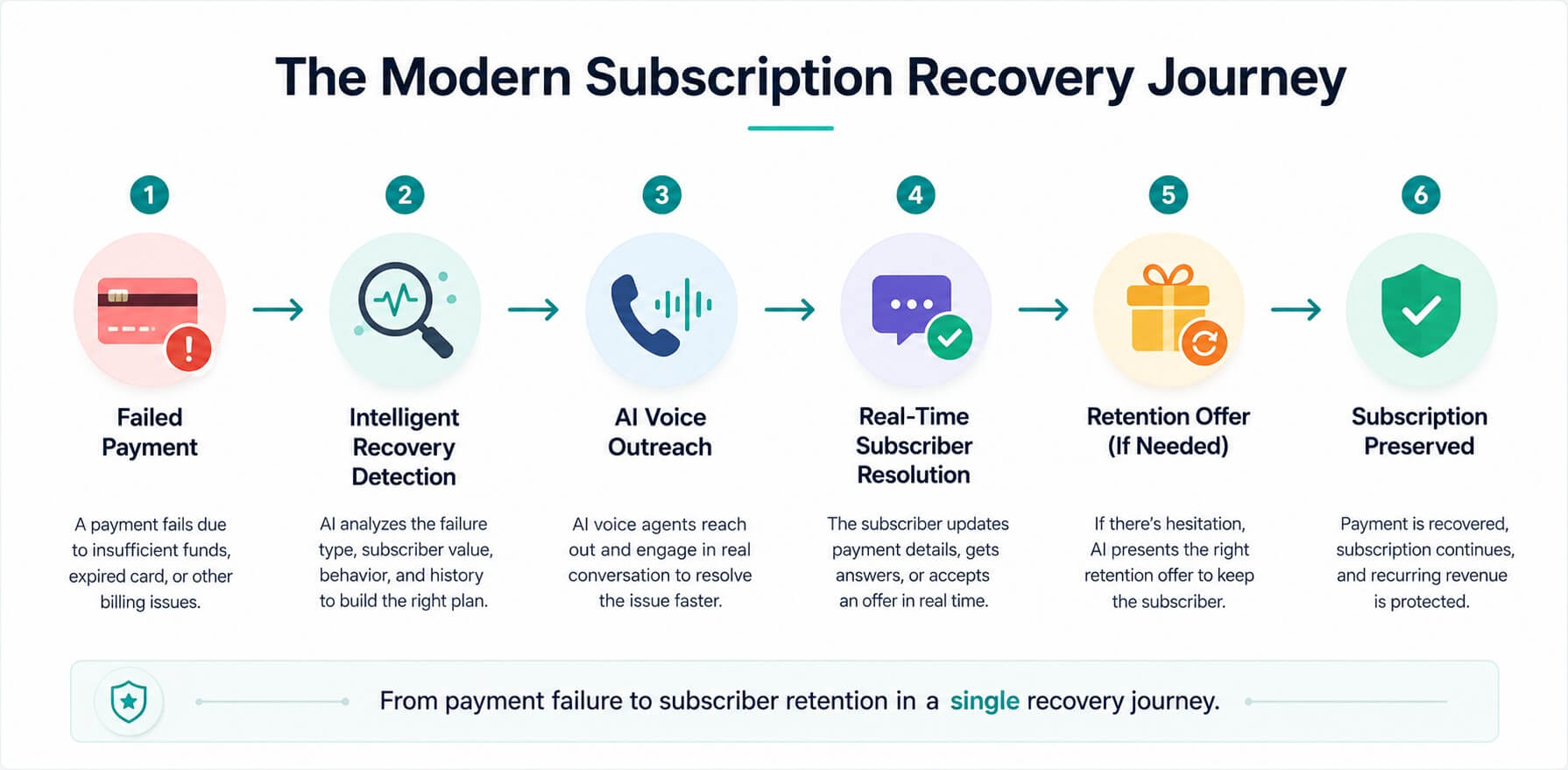
For example, a subscriber who repeatedly ignores recovery emails may respond immediately to a proactive voice interaction that explains the issue clearly and provides a secure payment resolution path in real time. Another subscriber nearing cancellation may respond better to flexible retention options such as pauses, skips, or modified subscription plans rather than repeated payment reminders.
enComm’s AI-assisted recovery conversations can support those retention-oriented interactions while keeping the subscriber engaged before churn becomes permanent.
That shift is important because modern subscription retention is no longer just about collecting failed payments. It is increasingly about preserving subscriber relationships before disengagement escalates into cancellation.
AI Voice Is Quietly Becoming a Retention Layer
One of the biggest strategic shifts happening inside subscription commerce is that payment recovery and customer retention are beginning to merge into the same operational function.
Historically, failed payments were treated as billing problems. Today, leading subscription brands increasingly view recovery as a customer lifetime value initiative because retaining an existing subscriber is usually far more profitable than acquiring a replacement. This is where AI voice interactions become especially valuable.
Unlike static email workflows, live conversations can identify hesitation, confusion, or churn risk earlier in the recovery cycle. More importantly, they can respond dynamically while the customer is still engaged.
Industry forecasts increasingly suggest AI agents could handle the majority of routine customer servicing interactions within the next several years, particularly structured workflows like subscription servicing, billing conversations, and account recovery.
For subscription brands, the opportunity is not about replacing support teams entirely. It is about building retention infrastructure capable of operating continuously, consistently, and proactively at scale.
That is ultimately why AI voice agents are outperforming both static dunning workflows and human-only recovery operations in subscription payment recovery.
They sit in the middle ground:
- more interactive than email,
- more scalable than manual outreach,
- faster than support queues,
- and more adaptive than rigid automation systems.
Most importantly, they help recover recurring revenue before churn becomes permanent. Our article on how AI helps increase subscriber CLV explores this shift in greater detail.
AI voice recovery is most effective when it operates as part of a broader retention strategy that includes churn prevention, cancellation saves, winback campaigns, and payment recovery. Our Complete Guide to Subscription Retention & Revenue Recovery explores how these components work together to protect recurring revenue throughout the subscriber lifecycle.

Final Thoughts
The conversation around AI in customer engagement is often framed incorrectly.
It is usually presented as humans versus AI, automation versus personalization, or efficiency versus customer experience.
But the strongest subscription recovery systems are moving toward orchestration instead of replacement.
AI voice agents are not becoming valuable because they perfectly imitate human conversations. They are becoming valuable because they solve a very specific operational challenge: helping subscription businesses respond to failed payments instantly, consistently, and at scale.
That combination is increasingly difficult to achieve through traditional dunning emails or manual recovery operations alone.
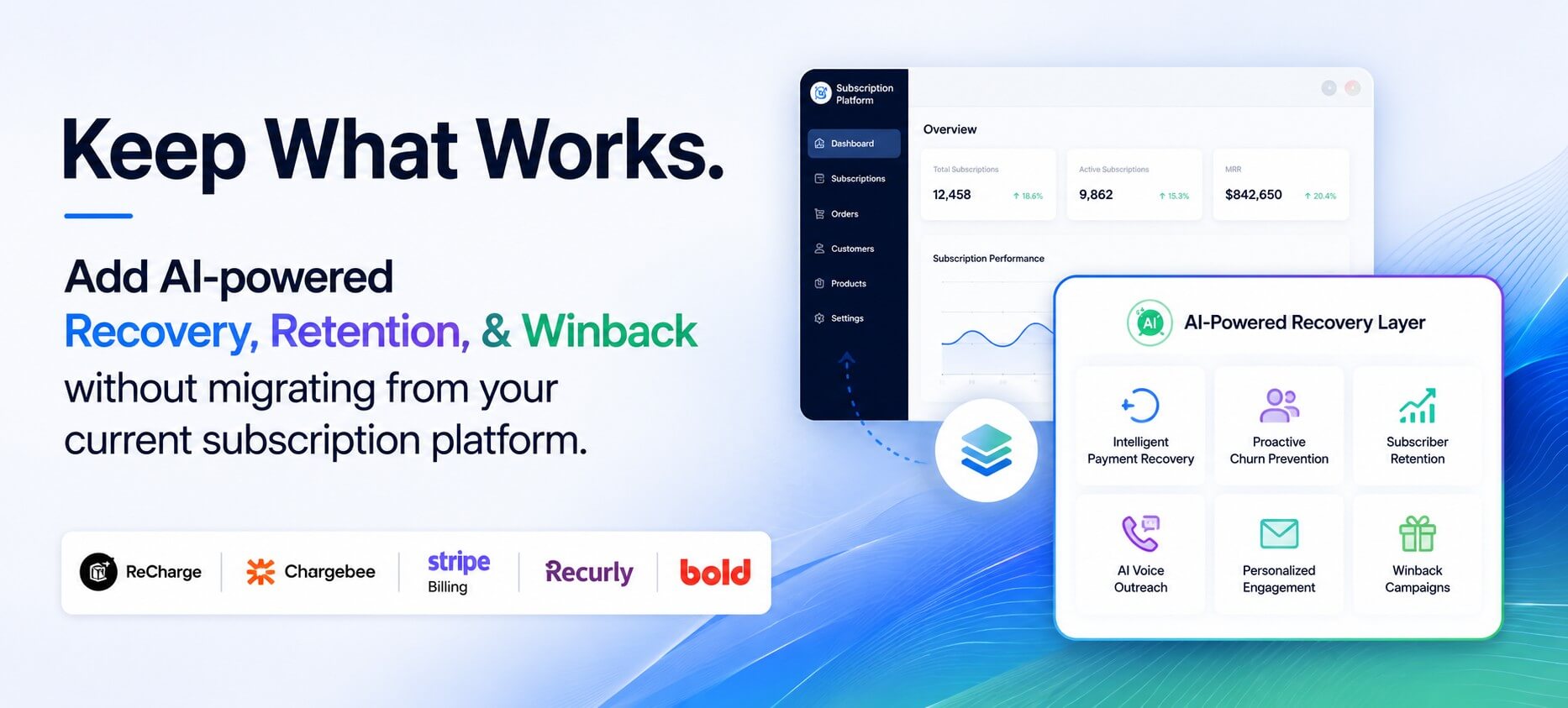
enComm’s approach reflects this shift directly by combining AI-powered recovery engagement, retention-focused workflows, and subscriber recovery infrastructure into a unified system built specifically for recurring revenue businesses. We explore this trend further in How enComm’s AI Platform Is Replacing Multiple Disconnected Subscription Retention Tools
As subscription competition increases and customer acquisition costs continue rising, retention efficiency becomes more important than ever.
And increasingly, AI voice recovery is proving to be one of the most practical ways to protect recurring revenue before it disappears.
Frequently Asked Questions About AI Voice Payment Recovery
Yes. For transactional conversations such as failed payment recovery, customers typically care more about speed and convenience than whether the interaction is AI-assisted. Recent industry research shows many consumers prefer immediate AI responses over waiting for human support when resolving routine account issues.
AI voice and email work best together, but voice recovery often drives faster resolution because it creates real-time engagement. Instead of waiting for customers to open and act on an email, AI voice conversations can immediately explain the issue and guide the subscriber toward resolution.
Yes. By helping subscribers resolve failed payments before subscriptions lapse, AI voice agents can recover revenue that would otherwise be lost to involuntary churn. This makes them a valuable retention tool as well as a recovery tool.
No. AI voice is most effective for structured, repetitive interactions such as payment recovery. Human teams remain essential for complex support cases, escalations, and relationship-driven customer interactions.
enComm uses AI-powered voice engagement to proactively reach subscribers after failed payment events, helping them understand the issue and complete the actions needed to maintain their subscription.