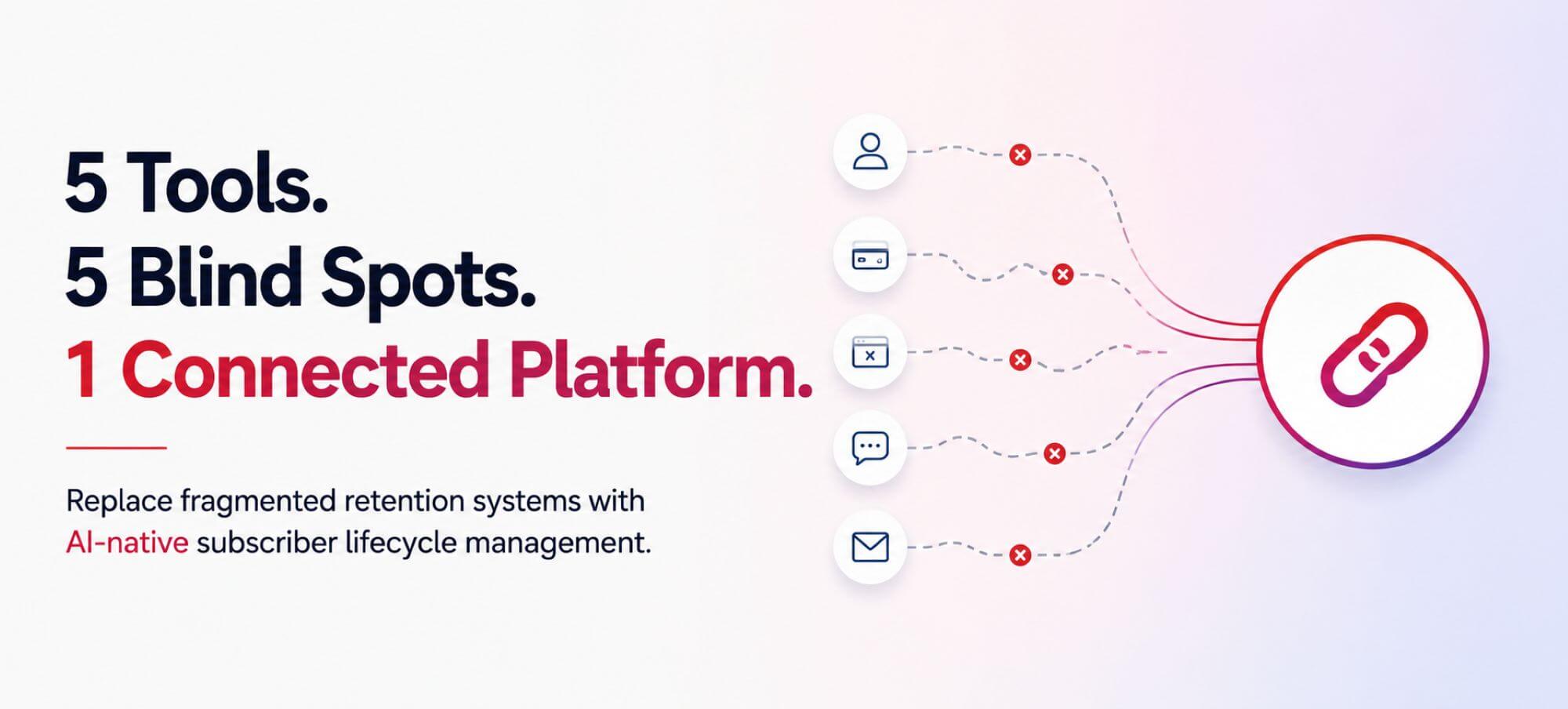
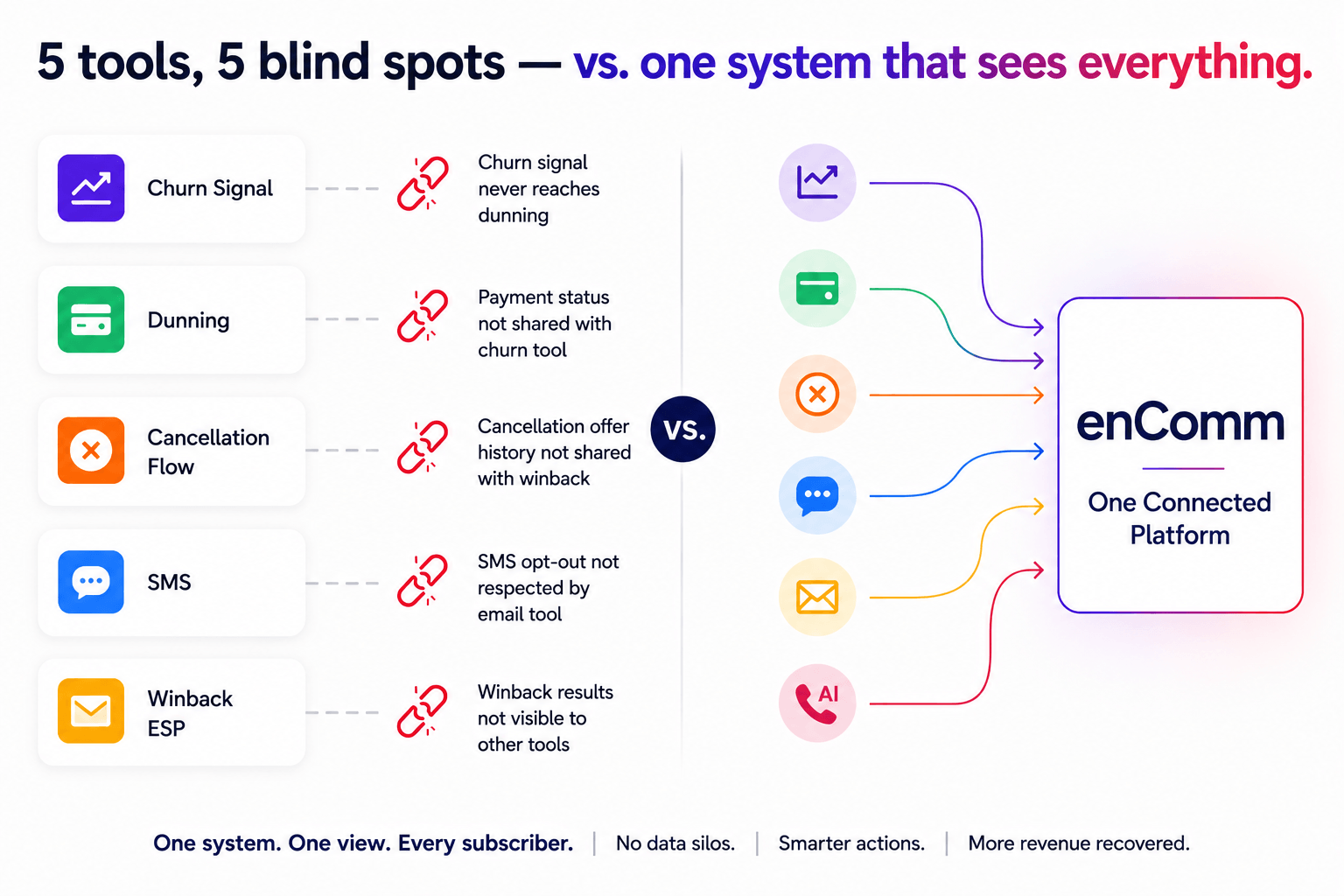
The average Shopify subscription brand in 2026 is running five, sometimes six, separate tools just to keep their subscribers from leaving. A churn prediction app. A dunning tool. A cancellation flow builder. An SMS platform. A winback email sequence inside their ESP. Each with its own login, its own data model, its own pricing, and — critically — no idea what the others are doing.
This patchwork isn't just expensive. It's actively working against you.
When your dunning tool doesn't know that a customer has already declined a discount during cancellation last month, it offers them the same discount again. When your churn prediction tool flags a subscriber as high-risk without knowing they have an open payment failure, you end up with conflicting outreach from two systems on the same day. When your winback email goes out to someone who already resubscribed through your SMS campaign, you look like you don't know who your own customers are.
Platform fragmentation is now one of the most cited operational headaches for DTC subscription operators, and the costs are measurable. Research from McKinsey shows that brands with fragmented, disconnected customer data leave significant personalization revenue on the table compared to those with unified customer profiles.
The fix isn't adding another tool. It's replacing the stack entirely.
Here's what most subscription brands are actually running, what breaks in each one, and how Encomm closes each gap.
App 1: A Churn Prediction Tool
These tools score subscribers for cancellation risk based on engagement metrics, purchase history, or both. The better ones produce a daily ranked list of at-risk subscribers. That's genuinely useful — knowing who's likely to leave is half the battle.
The gap: They tell you who is at risk and stop there. Acting on that signal is your problem. And they have no visibility into whether the flagged subscriber is already in a payment recovery flow, has an open dunning case, or received a retention offer six days ago. Risk without connected action creates noise — or worse, conflicting outreach from two systems that don't know the other exists.
What Encomm does instead: Encomm doesn't stop at identifying subscribers who may be at risk. It continuously monitors subscriber behaviour and engagement signals, helping brands understand when intervention may be needed before a cancellation occurs.
More importantly, retention actions are connected to the broader subscriber journey. Rather than operating as a standalone alert system, Encomm automatically coordinates retention efforts with other subscriber lifecycle activities, helping brands deliver more relevant outreach. No duplicate outreach. No conflicting signals from tools that don't know each other exist.
App 2: A Dunning / Payment Recovery Tool
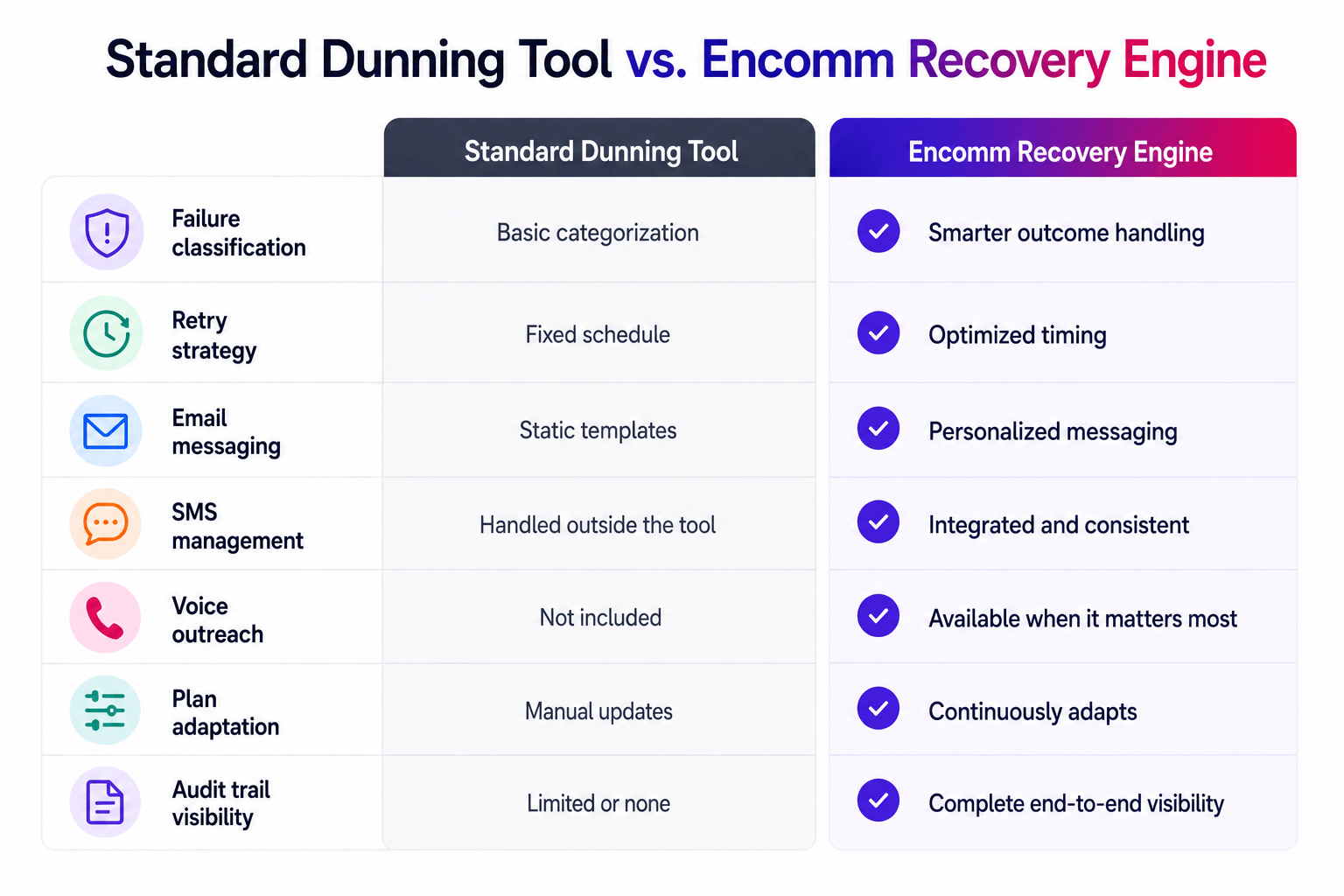
When a payment fails, this tool retries it on a fixed schedule and sends templated emails. Retry on day 3, day 7, day 14, regardless of why the card failed, who the customer is, or whether they respond to email at all. A customer whose card was reported stolen gets the same sequence as someone who temporarily ran short of funds. Both receive the same "please update your payment method" email, written for nobody in particular.
The gap: Fixed sequences treat every failure as the same failure. They don't classify the decline type, so they waste retry attempts on permanently invalid cards. They don't adapt to the customer's profile, so a high-value subscriber of three years gets the same low-touch response as a first-month subscriber. And they stop at email, which means every customer unreachable by email is effectively unrecoverable.
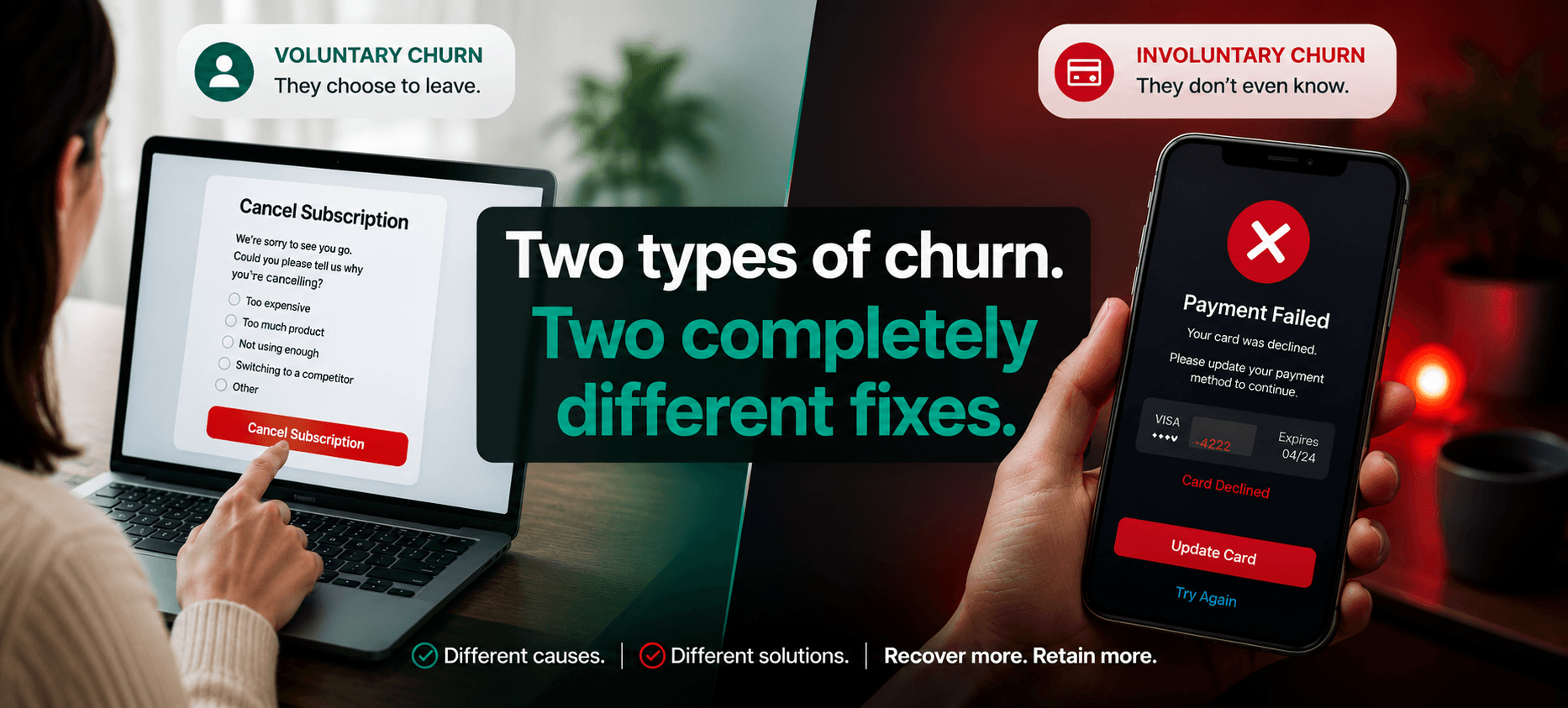
Many subscription brands underestimate how much revenue is lost through failed payments alone. Learn why 30–40% of subscriber churn is actually involuntary and how modern recovery systems address it.
What Encomm does instead: Encomm approaches payment recovery as a subscriber retention problem, not simply a billing problem. Instead of applying the same recovery sequence to every failed payment, the platform adapts recovery actions based on the subscriber's situation and the nature of the payment issue.
Recovery journeys are coordinated across multiple channels and continuously updated as new subscriber actions occur. This allows brands to deliver more relevant recovery experiences while reducing unnecessary outreach and improving the chances of successful payment resolution. Every step, every timing decision, and the rationale behind it is visible in the dashboard.
App 3: A Cancellation Flow Builder
These tools intercept subscribers at the moment of cancellation and present a retention offer. A good one matches the offer to the stated cancellation reason. A basic one shows a coupon to everyone and calls it personalisation. Either way, the offer gets accepted or declined — and then the tool's job is done.
The gap: Cancellation flow tools operate in complete isolation. They don't know what discounts this subscriber already received in a winback campaign three weeks ago — so they'll offer the same discount again, which the customer now knows to expect. They don't feed their outcomes back into the churn risk model. They hand off nothing to the dunning tool if the customer accepts a pause offer and then their next payment fails. Every save is a dead end, data-wise.
What Encomm does instead: When a subscriber reaches the point of cancellation, Encomm helps brands present retention alternatives that are relevant to the subscriber's circumstances rather than relying on a one-size-fits-all offer strategy.
Because cancellation is treated as part of a broader lifecycle rather than an isolated event, information gathered during the retention process remains available throughout future subscriber interactions. This creates a more consistent experience and helps prevent repetitive or conflicting retention efforts later in the journey.
App 4: An SMS Platform
SMS recovery sequences are standard practice now. Most brands run them through Attentive, Postscript, or Klaviyo SMS — separate from wherever email dunning lives. Each platform does its job. The problem is they do it independently.
The gap: When SMS and email dunning run in separate systems, there's no shared suppression and no shared outcome tracking. A customer clicks your SMS link, updates their card, and resolves the issue — your email dunning system doesn't know, and sends the "please update your card" follow-up anyway. A customer replies STOP to an SMS in one campaign, but that opt-out doesn't automatically propagate to the email tool or to future SMS steps in a different flow. The customer who resolved their issue still gets chased. The customer who opted out still gets contacted. Both outcomes damage trust.
What Encomm does instead: Within Encomm, SMS is not managed as a separate retention channel operating independently from the rest of the subscriber experience. Instead, it works alongside email, recovery journeys, retention campaigns, and other subscriber communications as part of a unified strategy.
This coordinated approach helps ensure that subscriber actions, preferences, and outcomes are recognised across the entire platform. The result is a more seamless experience that reduces communication overlap and improves overall engagement.
App 5: Winback Sequences in Your ESP
Post-cancellation winback is typically a flow inside Klaviyo or another ESP. Time-based: day 7, a "we miss you" email. Day 14, a discount. Day 21, a final nudge. These flows are built once, applied to everyone, and left to run. They don't know why the customer cancelled. They don't know their LTV. They don't know whether the customer already saw and rejected that exact discount in the cancellation flow two weeks ago.
The gap: Winback that ignores why someone left will always underperform winback that responds to it. Leading with a price discount to a customer who cancelled because of a product quality issue doesn't just fail to convert — it signals you weren't listening. And repeating an offer the customer already turned down is worse than saying nothing.
What Encomm does instead: Encomm treats winback as a continuation of the subscriber relationship rather than a generic post-cancellation email flow. Winback campaigns are informed by the subscriber's history, previous interactions, and lifecycle context, helping brands deliver more relevant re-engagement experiences.
Because winback activity is connected to the same retention and recovery platform, subscriber interactions remain consistent across every stage of the lifecycle. This helps brands avoid repetitive offers and create a more personalised path back to an active subscription.
One Thread Running Through All Five
Each of these gaps has the same root cause: tools built to solve one problem, with no visibility into what the others are doing.
Your dunning tool optimises for payment recovery rate. Your cancellation flow tool optimises for save rate. Your churn prediction tool optimises for risk identification. None of them optimises for subscriber lifetime value, because none of them can see the whole picture.
When your retention systems share context, they stop working against each other. When a customer's churn intent informs their dunning plan. When their engagement history informs their winback sequence. When their email engagement determines whether SMS is even worth trying. When every interaction is aware of every prior interaction, that's when recovery & retention rates move.
The impact extends beyond retention rates. When recovery, retention, and reactivation work together, the gains compound into significantly higher subscriber lifetime value. Learn how AI engagement can increase subscriber CLV by 40–60% over 12 months.
Encomm merchants see up to a 20% average subscriber reactivation rate and recover up to 3x more failed payments than merchants on standard dunning tools. These outcomes aren't from any single feature; they're from the compounding effect of a system that treats every subscriber as one continuous relationship, not a ticket in five separate queues.
What to Do If You're Running the 5-App Stack Today
If you're currently stitching together churn prediction, dunning, cancellation flows, SMS recovery, and winback sequences across multiple tools, the question isn't whether to consolidate; it's when.
The longer you run fragmented systems, the more revenue leaks through the gaps. Every time your dunning tool and your winback email hit the same subscriber on the same day with conflicting messages, you're not just leaving money on the table but actively damaging the relationship you're trying to save.
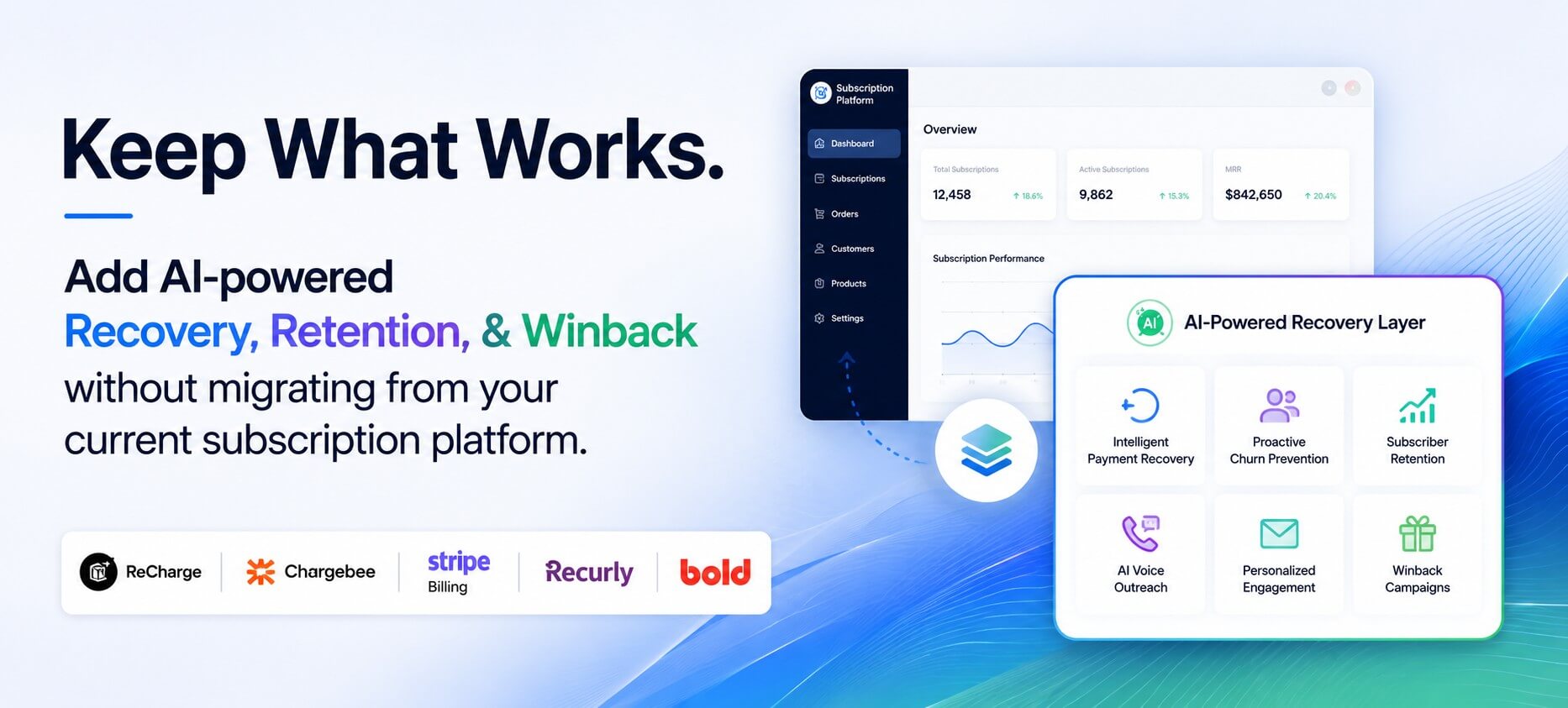
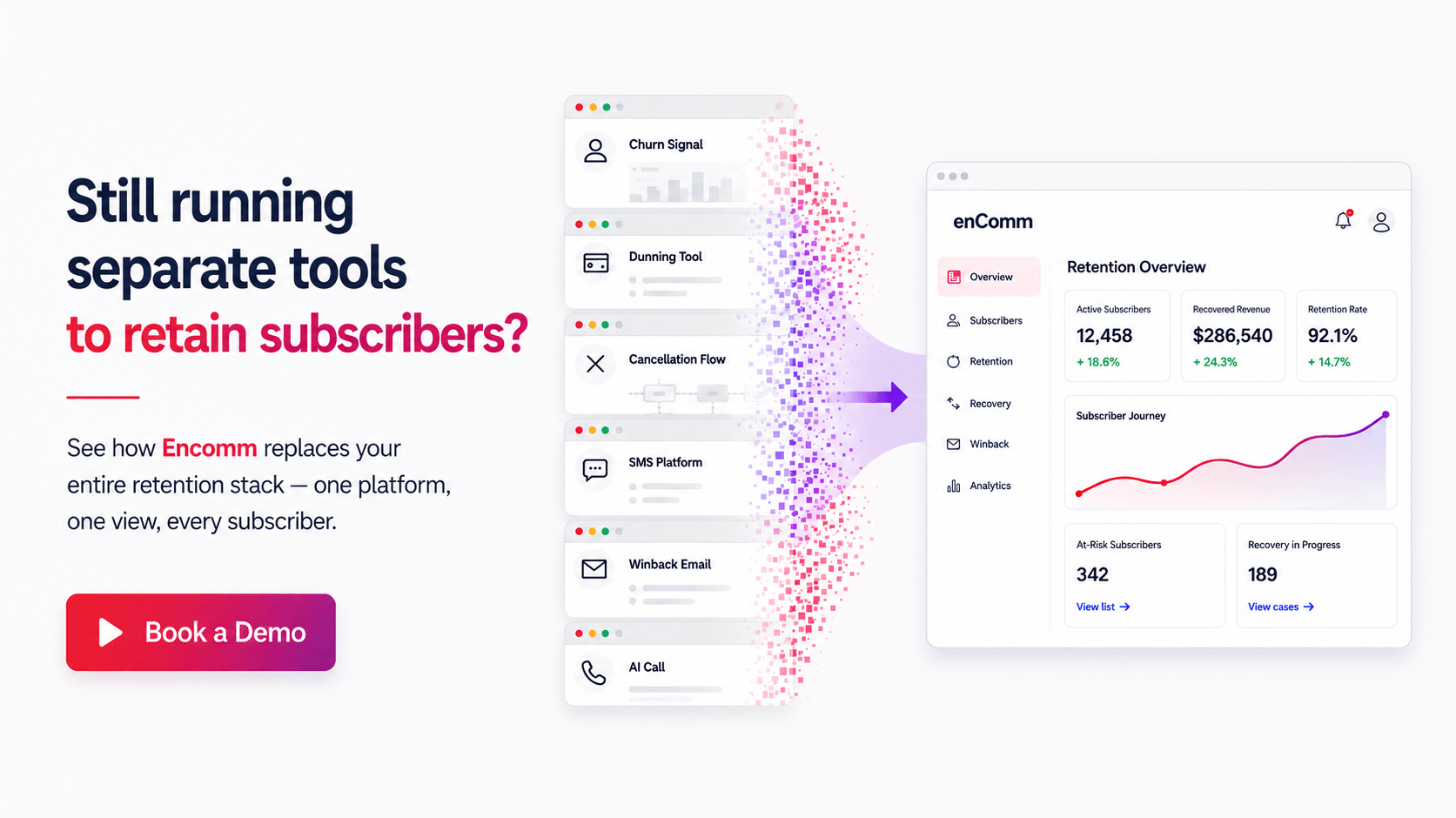
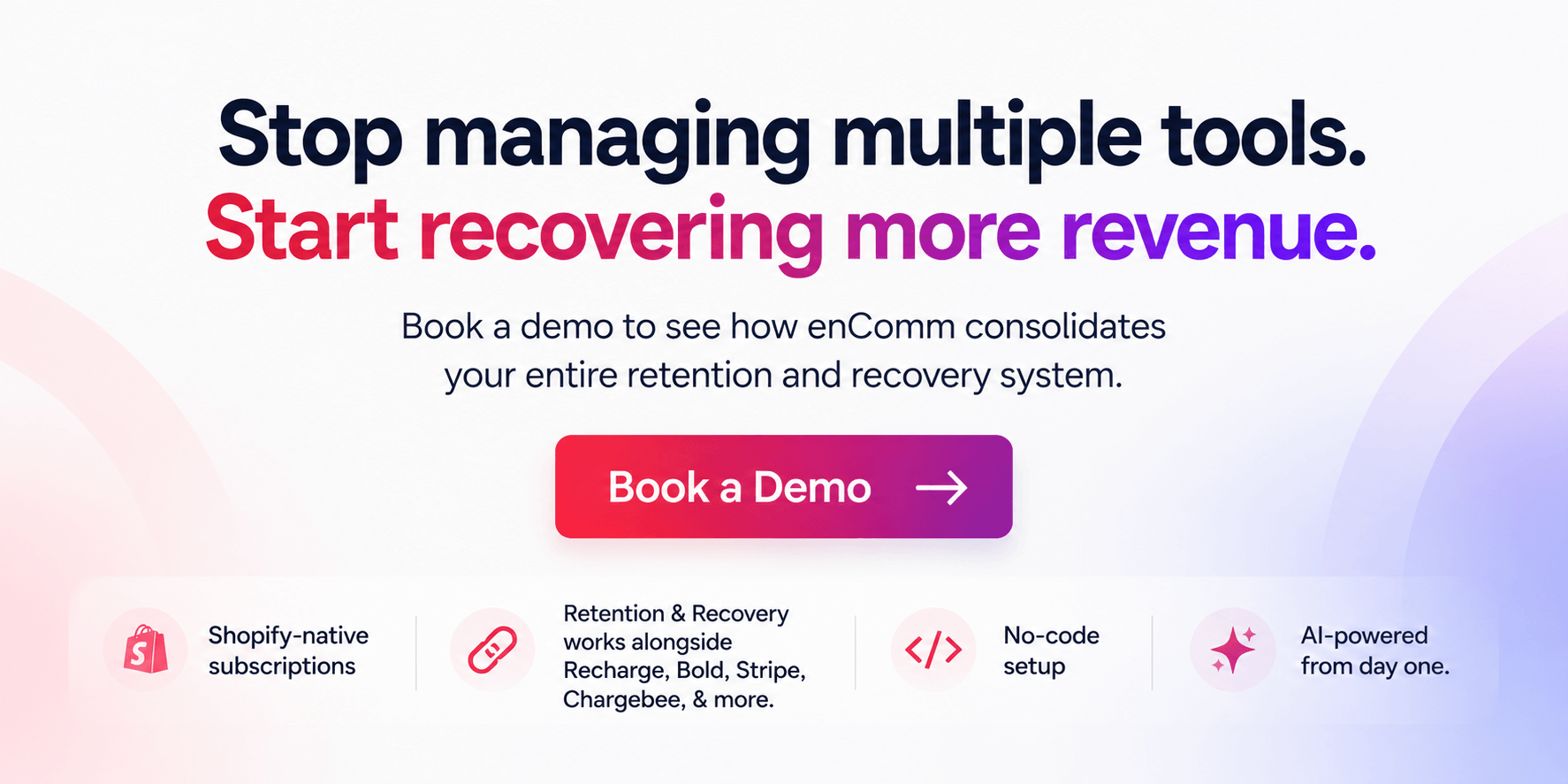
Encomm is built natively on Shopify's subscription infrastructure, connects to your existing tools (Klaviyo, Attentive, Postscript), and imports your subscriber data automatically at setup. No CSV export. No manual migration. No downtime for your existing subscribers. The recovery engine starts working from day one.
Running a fragmented retention stack is costing you more than the tool subscriptions. It's costing you recovery rates.
Compare enComm pricing plans to see how a single platform can replace multiple retention and recovery tools.
For a complete picture of how modern subscription brands protect and grow recurring revenue across the full subscriber lifecycle, read our Complete Guide to Subscription Retention and Revenue Recovery.