
44% of Cancellations Happen in the First 90 Days
You’ve done the hard part. You ran the campaign, optimised the landing page, and got someone to subscribe. Then, less than three months later, they’re gone.
This isn’t bad luck. It’s a pattern — and the numbers back it up.
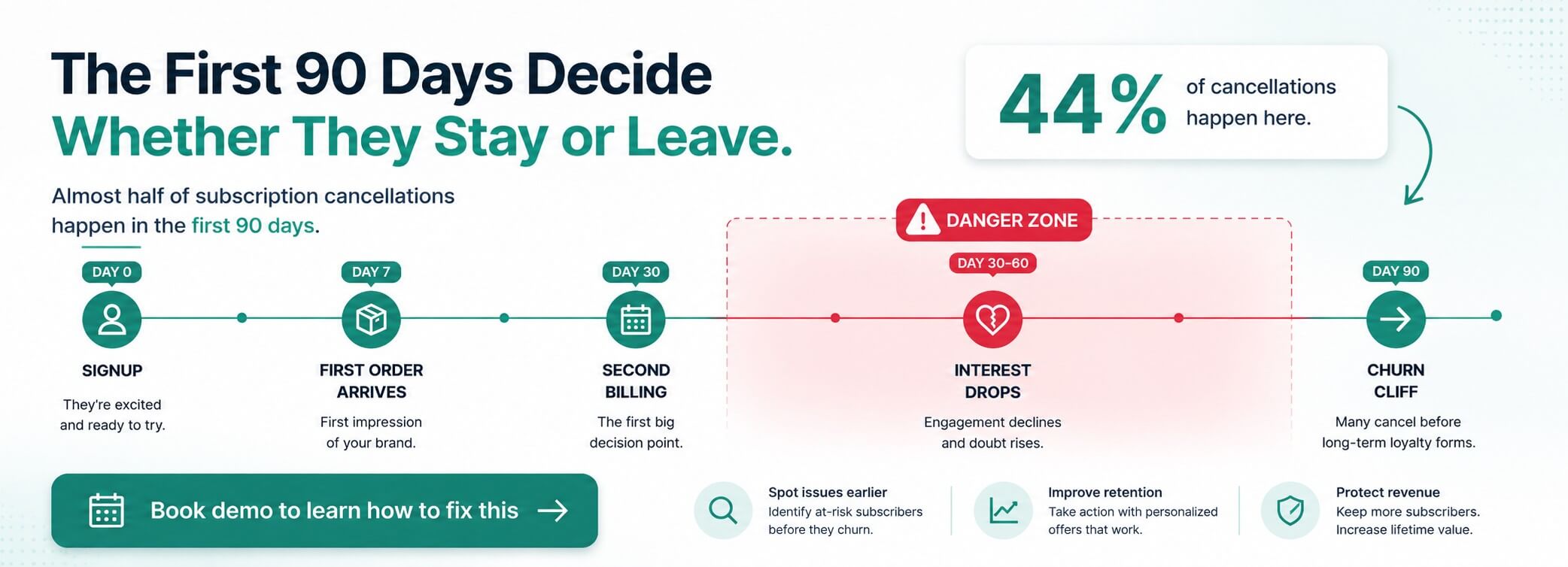
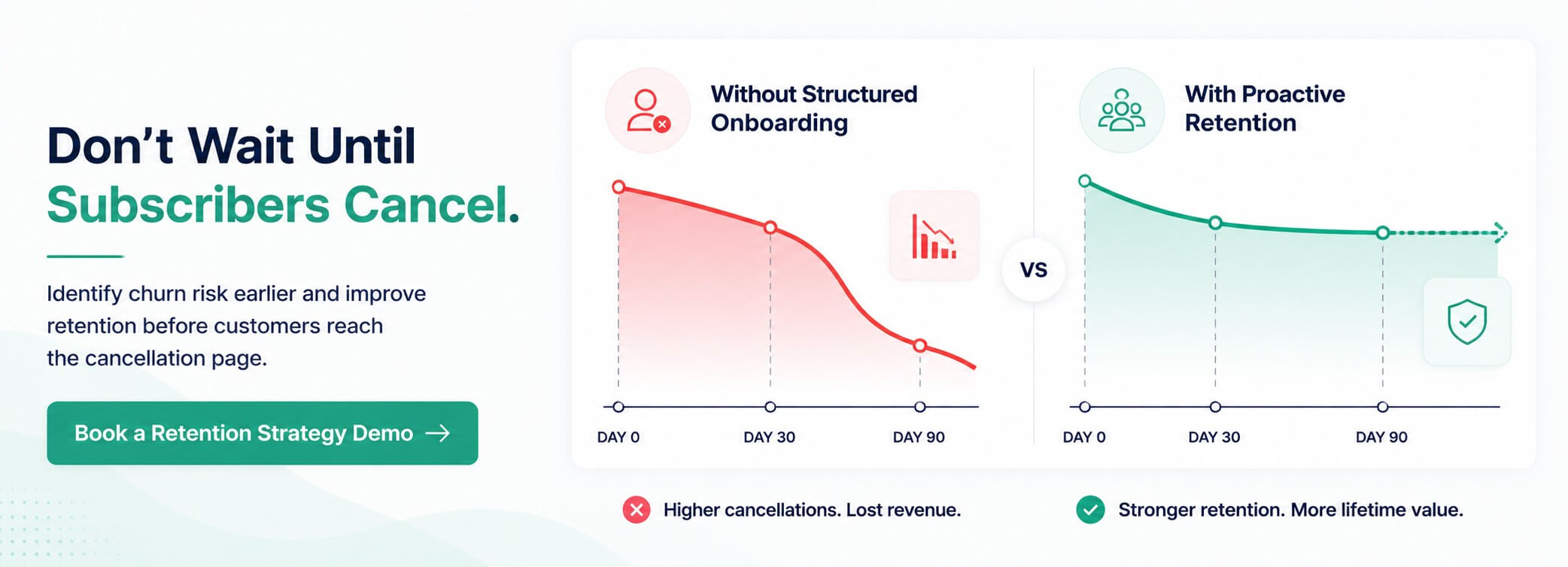
44% of all subscription cancellations happen within the first 90 days. Nearly half your churn is concentrated in a window that most brands spend almost no time thinking about once the conversion fires. New subscribers come in the front door, and nearly half quietly leave before the fourth billing cycle.
If you’re optimising your cancellation flows, your dunning sequences, and your winback campaigns before you’ve fixed what happens in those first 90 days — you’re patching the wrong end of the pipe.
This guide is about that window. Why it’s so dangerous, what’s actually driving it, and what you can do to close it.
Why Do Subscription Customers Cancel So Early?
Most subscription cancellations happen because customers fail to build a habit before the second or third renewal. In the first 90 days, subscribers are still deciding whether the product fits into their routine. If they do not understand how to use the product, do not see value quickly enough, or are unaware of options like skip, pause, or frequency changes, cancellation becomes the easiest path.
The difference between average subscription retention (31%) and top performers (45–55%) comes down almost entirely to whether the business has a structured post-purchase programme designed to create habitual value early. The brands in that top tier aren’t just offering a better product; they’ve built a better first experience, one that teaches subscribers why the product is worth keeping before the second billing cycle arrives.
Three things drive first-90-day cancellations more than anything else:
Subscribers never form the habit. A new subscriber is still evaluating. If your onboarding doesn’t help them integrate the product into their routine, through education, expectation-setting, and early wins, they’ll cancel the moment it feels like friction rather than a solution.
This is why onboarding is increasingly viewed as a retention function rather than a customer service function. According to HubSpot’s customer onboarding guide, helping customers achieve value early in their journey significantly improves long-term engagement and satisfaction.
Subscribers don’t know they can adjust. “Too much product” is one of the most common early cancellation reasons. But the subscriber doesn’t know they can skip a delivery, reduce their frequency, or pause for a month. So they do the only thing that feels available: cancel. Flexibility doesn’t reduce cancellations if subscribers don’t know it exists.
The brand goes silent after the first order. In one audit of a DTC subscription brand, the onboarding flow was almost completely silent after the first order — no education, no engagement, no value reinforcement. Adding three short educational touchpoints about “how to get the best results” reduced churn by 14%. This is the norm, not the exception.
What Onboarding Actually Means Here
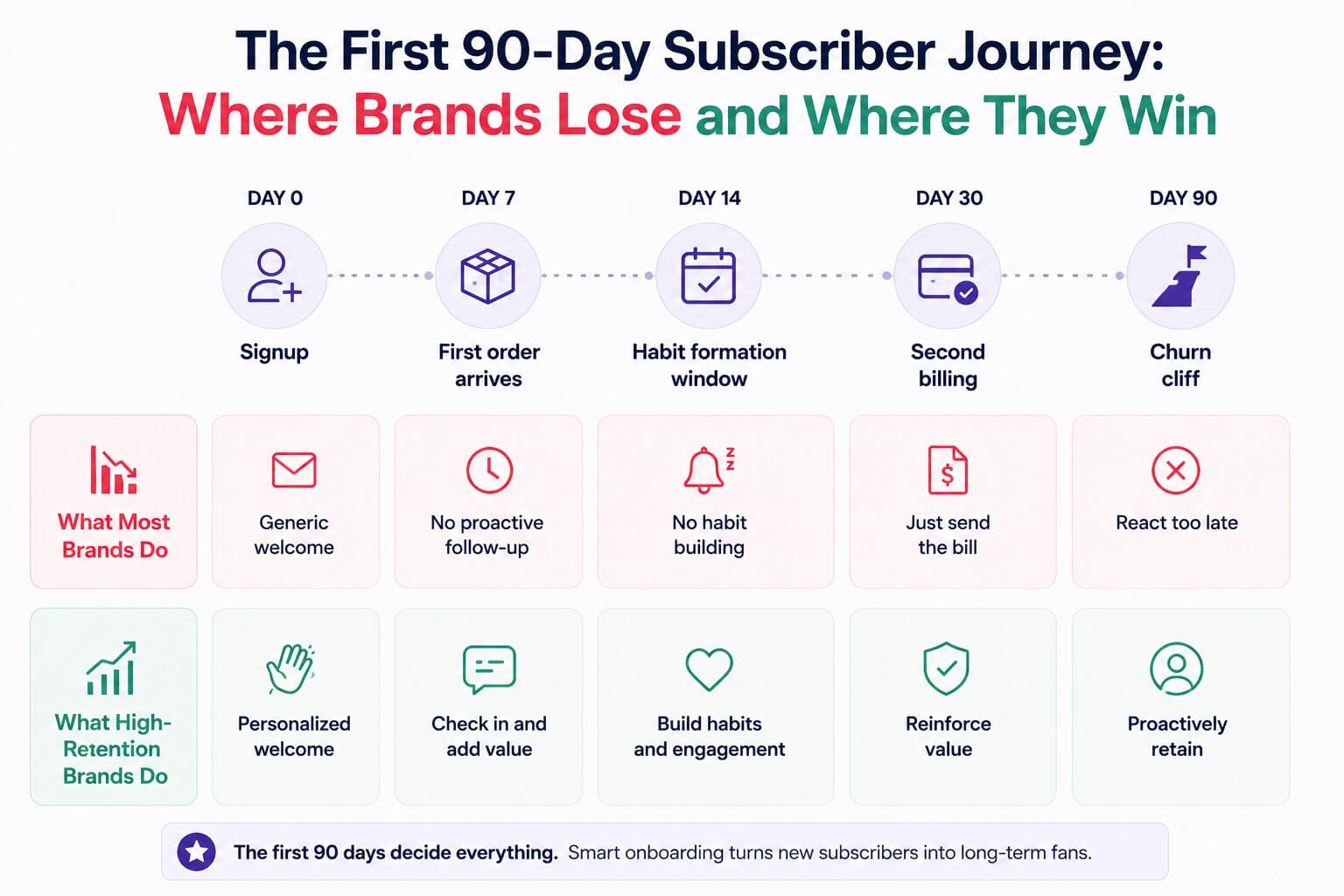
Most brands send an order confirmation and call it onboarding. That’s a receipt, not a retention system. A real subscriber onboarding programme needs to do three things in the first 30 days:
Teach them how to use the product well. Not what it is — they already bought it. What results should they expect, and when? A skincare subscriber needs to know when they’ll see changes. A supplement subscriber needs to know when and how to take it. Without this, “product isn’t right for me” becomes the cancellation reason, even when the product is fine.
This matters because subscriber loyalty is often shaped by the experience customers receive after purchase, not just the product itself. PwC’s customer loyalty and experience survey found that consistent, value-driven experiences play a major role in whether customers continue their relationship with a brand.
Make flexibility visible. Don’t bury skip and pause options in a FAQ. Surface them proactively: “Got too much? You can skip your next delivery anytime.” Subscribers who know they can adjust are significantly less likely to cancel outright.
Set clear billing expectations. A pre-billing reminder arriving two or three days before the next charge — with a clear amount and date — removes friction and builds trust. Surprise charges generate disputes and cancellations. Expected charges generate goodwill.
The Signals That Predict Early Churn, Before It Happens
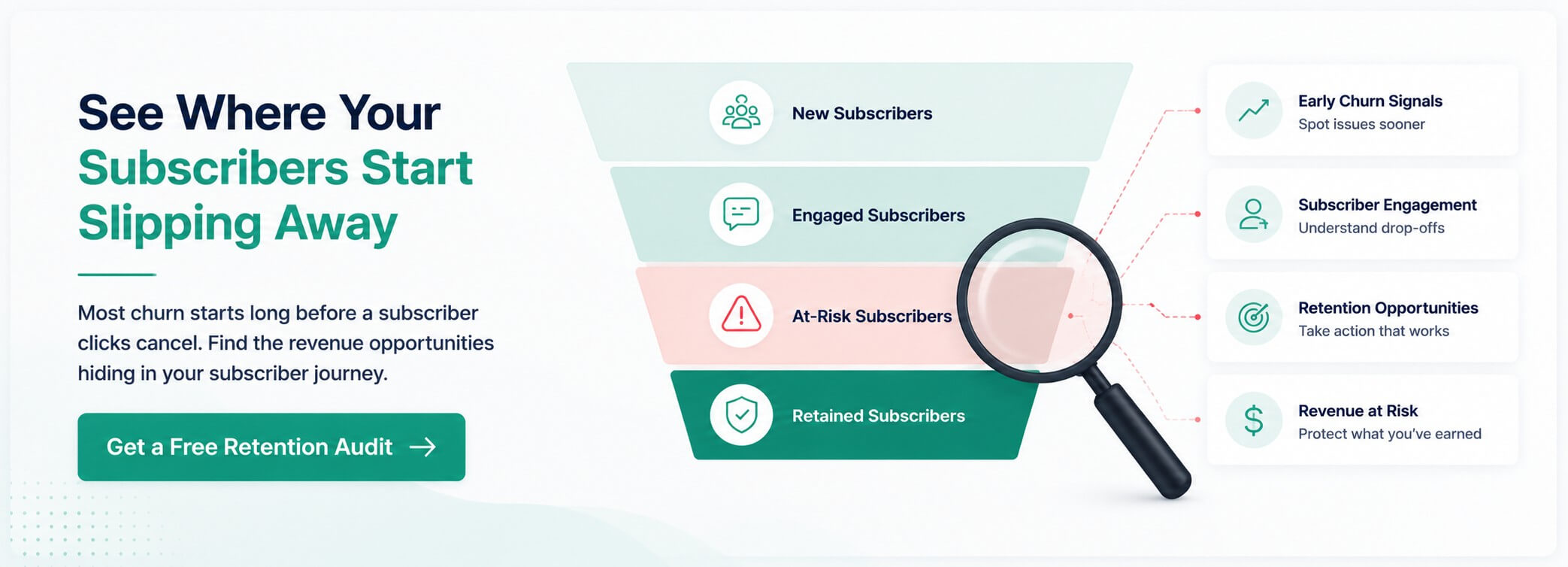
By the time a subscriber hits cancel, you’ve already lost most of your leverage. The good news is that early churn rarely arrives without warning. According to SubJolt’s recent churn rate benchmarks, voluntary churn accelerates well before cancellation, with product usage declining by an average of 41% in the quarter preceding it. Which means proactive engagement triggered by early drop-off signals can intercept a meaningful share of first-90-day losses.
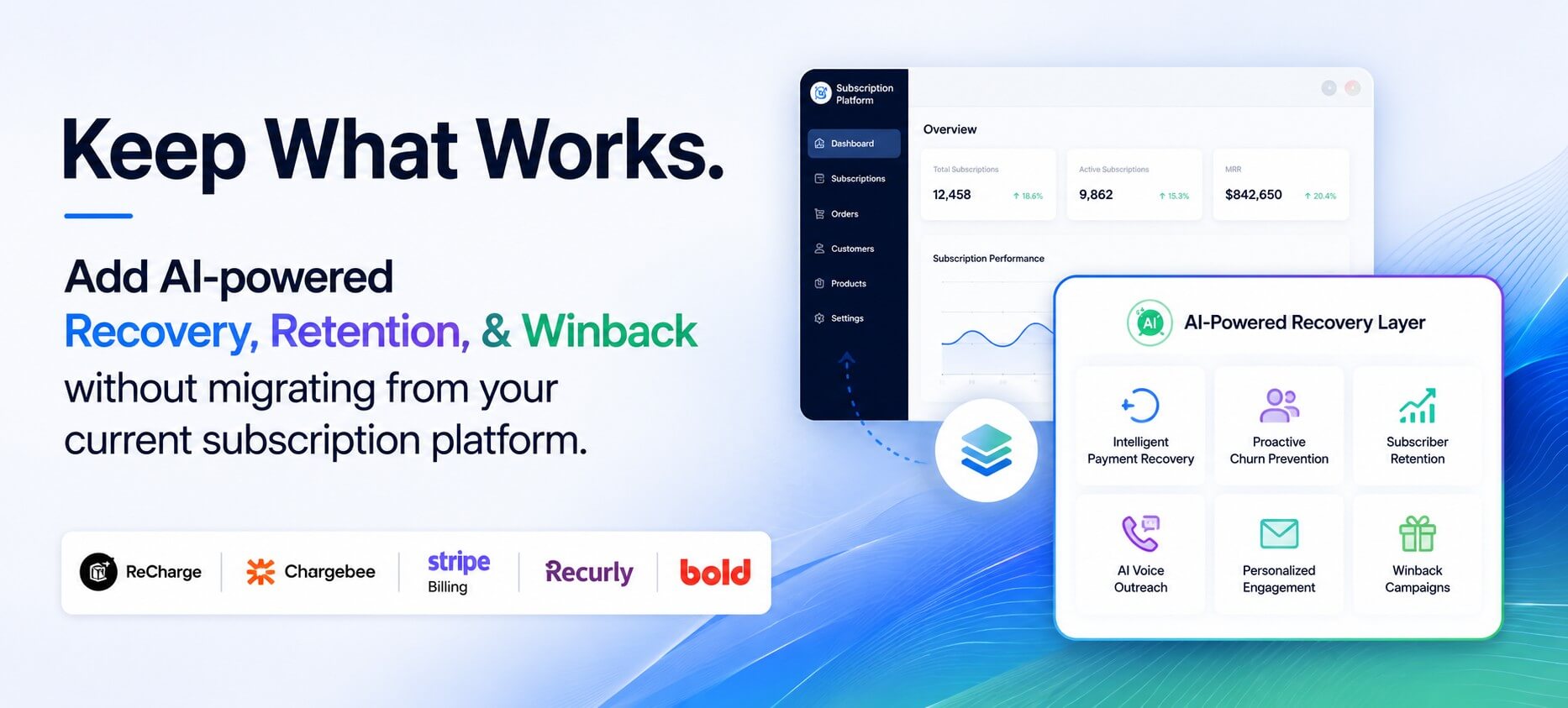
This shift from reactive retention to proactive intervention is one of the biggest changes happening in subscription commerce today. Rather than relying on disconnected retention apps that only activate after a cancellation attempt, leading brands are increasingly investing in systems that identify churn risk earlier and act before subscribers reach the cancellation page. We explore this evolution in more detail in our guide on how AI is replacing traditional subscription retention tools.
For subscription brands, the observable signals to watch are:
- Email engagement drops after the welcome sequence ends. A subscriber who opened your first three emails and then goes dark is worth flagging.
- An order skip in the first two billing cycles. A subscriber who skips their second order is at a meaningfully higher risk than one who doesn’t.
- A failed payment, even if recovered. A billing issue in the first 90 days is a churn risk signal, not just an operational event.
- No interaction with the self-service portal. Engaged subscribers check their next order date, adjust preferences, update addresses. Disengaged ones don’t.
Encomm’s proactive churn prevention monitors these signals daily for every active subscriber and generates a risk score. When a subscriber in their first 90 days crosses into medium or high risk, the system can automatically send personalised re-engagement outreach — or, for high-risk subscribers, present a targeted retention offer before they’ve visited the cancellation page. That’s the retention conversation happening when there’s still leverage: before the decision, not after it.
What Actually Happens at Cancellation, And Why It’s a Safety Net, Not a Strategy
A well-designed cancellation save flow is valuable and every subscription brand should have one. But if 44% of your churn is concentrated in the first 90 days, a save flow is not the solution to an onboarding problem. It’s a recovery mechanism for a failure that started weeks earlier.
That said, what happens at the cancellation moment still matters — and most brands get it wrong. The most common mistake is a generic “Are you sure?” screen that ignores why the subscriber is leaving. First-90-day churners are often leaving for reasons with straightforward fixes:
- “Too much product” → A skip or frequency reduction would have kept them
- “Too expensive” → A pause or a modest discount on the next order might have kept them
- “I forgot I had this.” → Better pre-billing communication would have kept them, but a pause option at cancellation might still save the relationship
A reason-matched save flow intercepts these and offers the specific fix the subscriber actually needs. enComm’s cancellation flow collects the reason first, then presents the most likely-to-work offer: skip for accumulation, discount for price, pause for overwhelm or forgetfulness, product swap for dissatisfaction. If the first offer is declined, a second meaningfully different offer follows, based on the subscriber’s LTV and what they’ve already been offered. When both are declined, the subscriber exits gracefully. But fewer reach that point than you’d expect.
The cancel flow is where you recover the ones you couldn’t reach in time. Onboarding is how you reduce how many get there in the first place.
For a deeper look at how proactive retention and payment recovery connect across the full subscriber lifecycle, see the Complete Guide to Revenue Retention for Subscription Brands.
And for a breakdown of how retained subscribers compound into long-term LTV, read our post on how the 40–60% CLV lift from AI-engaged customers actually works.
Where Encomm’s Proactive Churn Prevention Fits Into This
Encomm’s proactive churn prevention runs daily risk scoring across every active subscriber — including those in their first 90 days — and watches for the behavioural signals that precede cancellation. When a subscriber’s score rises, the system can automatically send personalised outreach or surface a targeted offer, before they’ve thought about leaving.
When subscribers do reach the cancellation page, Encomm’s intelligent save flow responds with the offer most likely to change their mind — matched to their stated reason, calibrated to their LTV, and aware of any offers they’ve previously received. A second offer follows if the first doesn’t land. And if they do cancel, an automated winback campaign begins — matched to the reason they left, not a generic re-engagement blast.
All of this runs on Shopify’s native subscription infrastructure, with zero transaction fees and no separate login for subscribers to manage their account.
The onboarding content — the emails, the education, the expectation-setting — belongs to your brand. The risk scoring, the proactive intervention, and the cancellation recovery? That’s where Encomm runs quietly in the background, holding the first 90 days together.
Frequently Asked Questions
First-90-day churn refers to subscribers who cancel within the first three months of joining a subscription program. It is often caused by weak onboarding, poor habit formation, unclear value, or billing-related friction.
The first 90 days are when subscribers are still evaluating whether the product is worth keeping. The habit hasn’t formed, the value hasn’t fully landed, and any friction — a billing surprise, confusion about how to manage the subscription, or product accumulating too fast — can tip them toward cancellation. Most brands don’t have structured onboarding that addresses these friction points before they become cancellation reasons.
Brands can improve Day-90 retention by educating subscribers after purchase, making pause and skip options visible, setting clear billing expectations, identifying at-risk subscribers early, and providing proactive retention interventions before cancellation occurs.
Across most subscription categories, the leading early-stage cancellation reasons are: product accumulating faster than it’s used, a recurring charge that feels like a surprise, and a general sense that the subscription hasn’t yet delivered clear value. Many of these are directly fixable without any change to the product itself.
At minimum: a welcome email that goes beyond the order confirmation, a product education email after first delivery, explicit mention of skip and pause options, and a pre-billing heads-up before the second charge. Each touchpoint should reduce friction and reinforce why the subscription is worth keeping.
Track a simple cohort: of subscribers who signed up in a given month, what percentage are still active at Day 30, Day 60, and Day 90? If your Day-90 retention rate is below 60%, the first 90 days deserve more attention than almost any other retention initiative.
Partially. A well-built save flow will recover some of the subscribers who reach cancellation. But it’s not a structural fix for an onboarding problem. Save flows add meaningful improvement on the subscribers who reach that point. Fixing why they reach it in the first place is the more durable gain.
The most consistent early warning signals are: declining email engagement after the welcome series, an order skip in the second or third billing cycle, a payment failure at any point in the first 90 days, and no interaction with the self-service portal. Identifying and acting on these signals while they’re still early is the core of proactive retention.