Every subscription business eventually runs into the same quiet problem: payments that used to go through stop going through, and nobody notices until the subscriber count starts drifting down. That's dunning territory — and how well a brand handles it is one of the highest-leverage, most under-managed levers in subscription commerce.
This post isn't about why payments fail — we cover that in detail in Why Subscription Payments Fail and How to Fix Them. This one is about the discipline of dunning itself: what it actually is, how to measure whether yours is working, and how the industry has evolved from fixed-schedule retry jobs toward something enComm calls adaptive payment recovery.
For the full strategic picture of how retention and recovery work together, start with our Complete Guide to Retention and Revenue Recovery.
What Is Dunning Management
Dunning management is the process of recovering failed recurring subscription payments using retries, customer communication, and payment updates before those failures become involuntary churn.
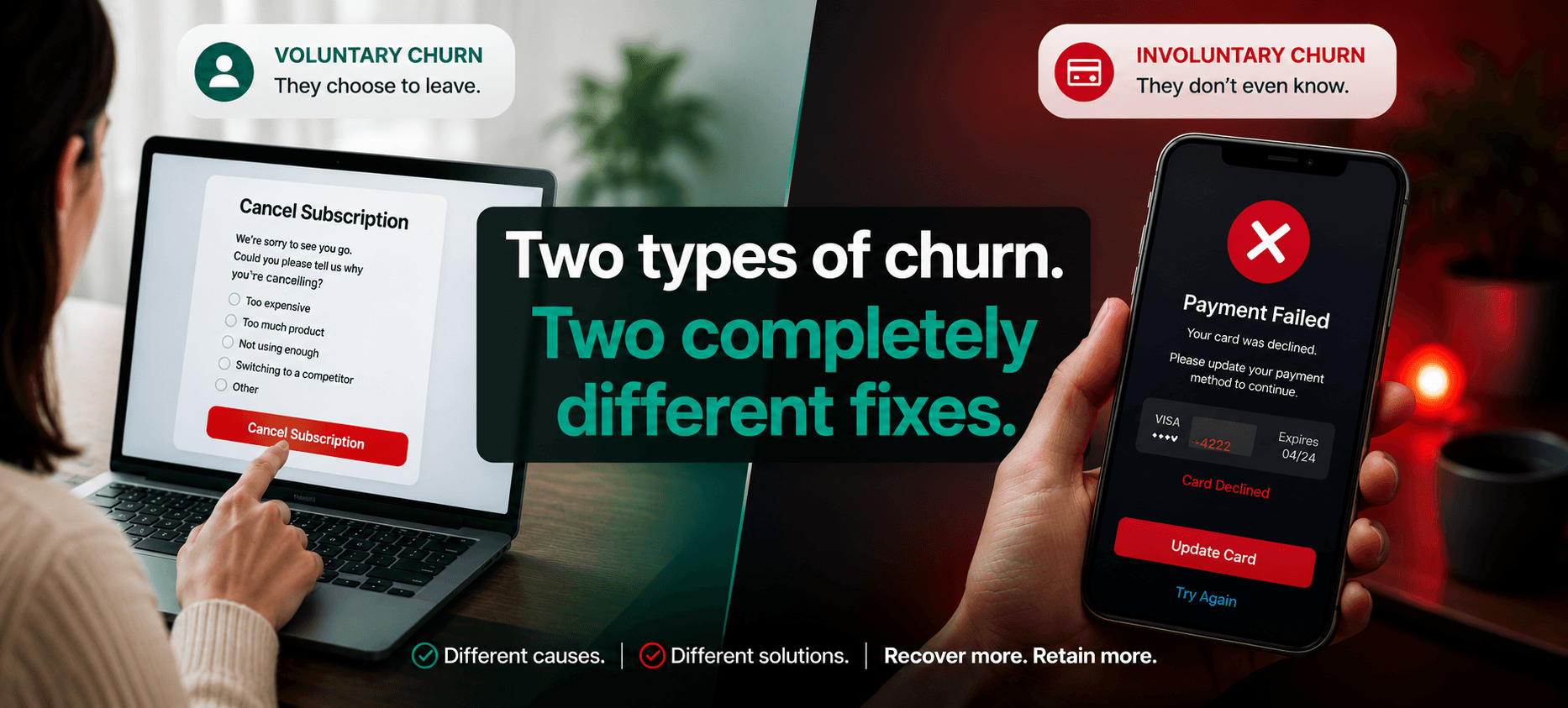
The word ‘Dunning’ has old-fashioned debt-collection roots, but modern dunning has very little to do with chasing someone down. Most of the customers in a dunning queue still want the product. Their card expired, their bank flagged a routine charge, or their balance dipped for a day. Dunning is simply the system that catches that and fixes it before the subscriber notices anything went wrong.
Treated as an afterthought — left to whatever default retry setting a payment processor ships with — dunning quietly leaks revenue every month. Treated as a real function with its own owner, metrics, and strategy, it becomes one of the most reliable sources of recovered revenue a subscription brand has, because unlike acquisition, it's revenue that's already been earned once.
Why Dunning Management Matters for Subscription Businesses
The scale of the problem is bigger than most finance and growth teams assume. Failed payments are estimated to quietly drain around 9% of monthly recurring revenue across subscription businesses — a figure that compounds every single month it goes unaddressed. And the businesses that treat dunning as a tracked, owned function rather than a background setting see meaningfully better outcomes than those that don't: companies that actively monitor and manage failed payments recover substantially more of that revenue and lose considerably less of it to involuntary churn than businesses that leave it on autopilot.
There's also a lifetime value angle that's easy to miss. A subscriber who's recovered from a failed payment doesn't just represent one saved transaction — data across the industry shows recovered subscribers typically continue for many additional months beyond the point of recovery. A dunning program isn't just protecting this month's charge; it's protecting the tail of revenue that follows it.
Dunning Management KPIs Every Subscription Business Should Track
A dunning program without metrics is a set of settings nobody's checked in months. A few numbers worth tracking on a recurring basis:
- Recovery rate — the share of failed payments that are eventually recovered, whether through a retry, a card update, or an offer acceptance.
- Involuntary churn rate — cancellations caused specifically by unresolved payment failures, tracked separately from voluntary cancellations, since the interventions for each are completely different.
- Time to recovery — how long, on average, it takes from failure to resolution. A high recovery rate that takes three weeks to land is a different program than one that recovers just as much in three days.
- Recovery rate by failure type — soft declines, hard declines, and authentication-required cases don't recover at the same rate, and blending them into one number hides where the actual problem sits.
- Recovery rate by channel — retries, email, SMS, and voice each close out a different share of cases, and knowing which one is actually doing the work tells you where to invest.
Reviewing these alongside voluntary churn and subscriber growth (not folded into a single generic churn number) is what turns dunning from a background process into a revenue recovery function someone can actually manage and improve.
From Fixed-Schedule Dunning to Adaptive Payment Recovery
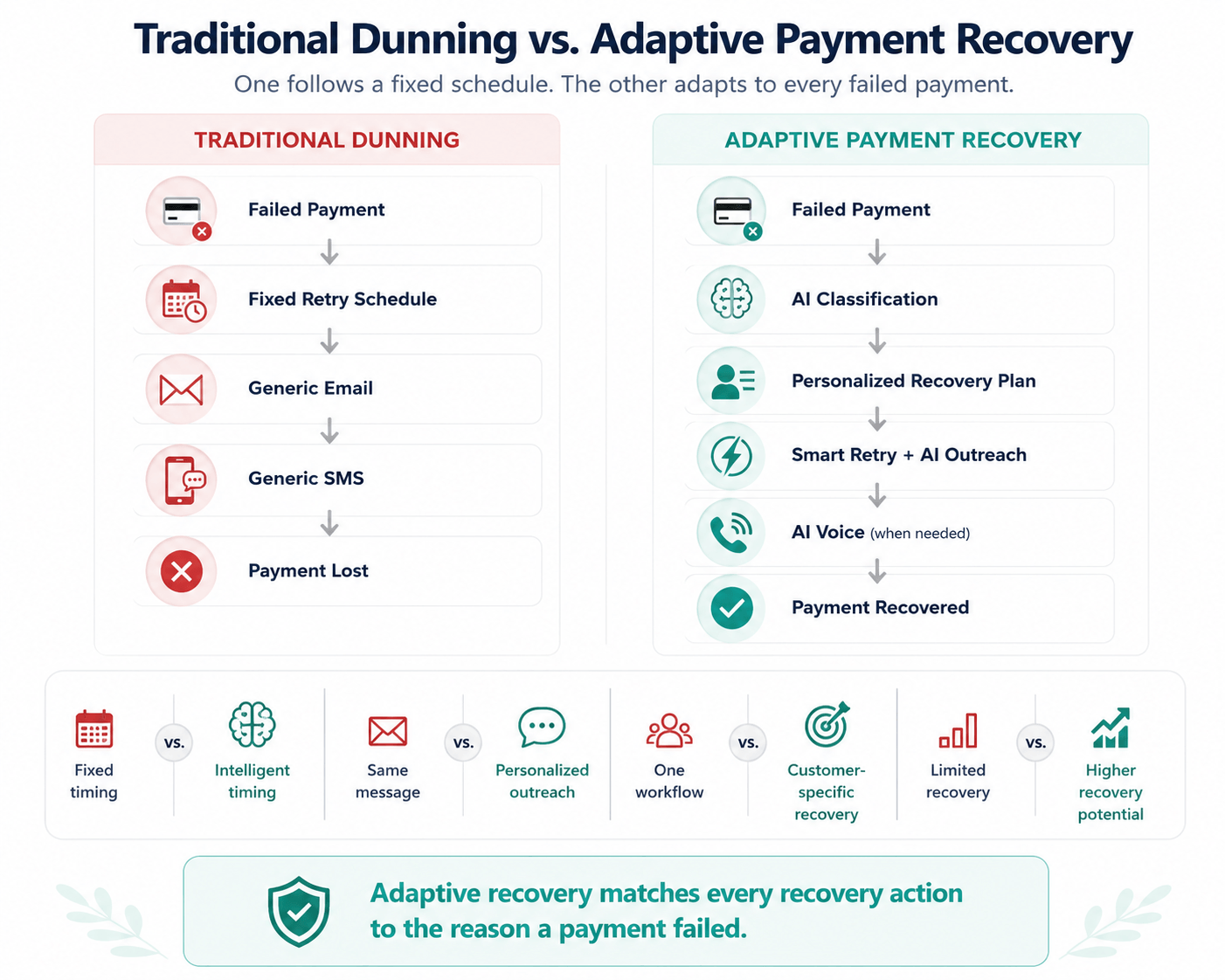
The traditional dunning model is a fixed retry schedule: attempt the charge again on day 3, day 7, and day 14, and send the same email template to everyone regardless of why the payment failed or who the subscriber is. It's simple to set up, and it's also why so much recoverable revenue never gets recovered. A fixed schedule treats a subscriber whose card is fine but just needs the right retry window the same way it treats a subscriber whose card is permanently dead.
The shift happening across the subscription industry is away from fixed-schedule dunning and toward adaptive payment recovery: reading the specific reason a payment failed, understanding who the customer is, and responding accordingly, rather than running every case through the same sequence. That's a meaningfully different approach, and it's the one enComm is built around.
How enComm's AI-Powered Payment Recovery Works
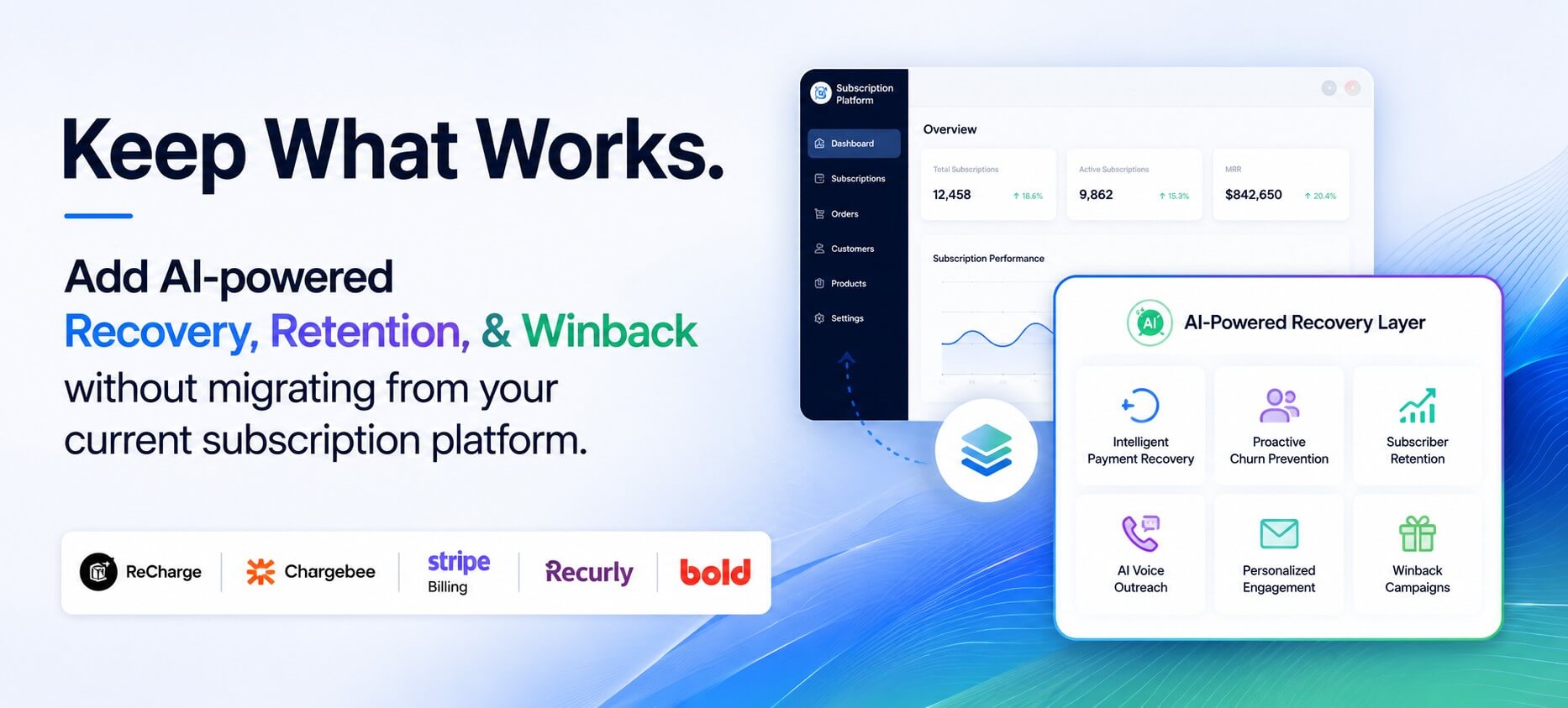
enComm doesn't run a traditional dunning sequence; it runs adaptive payment recovery. The engine starts by classifying every failed payment as a soft decline, hard decline, authentication required, or an AI-interpreted ambiguous case, before any retry or message goes out, so a temporary insufficient-funds hold and a permanently dead card never get treated the same way. From there, the system builds a recovery plan suited to that specific customer: their value, tenure, and communication preferences shape how fast and through which channels the outreach happens, rather than running everyone through one fixed track.
A few of the components working underneath that:
- Smart-timed retries that account for the failure type and the customer's own billing history, rather than firing on a flat calendar schedule.
- AI-generated email and SMS written for the specific customer and situation, not a template with a name inserted.
- AI voice calling as an escalation channel for cases where written outreach hasn't resolved the issue — a real, adaptive conversation that can walk a customer through a card update, answer questions, or offer a retention option on the spot, not a recorded message.
- A branded recovery page that every channel points to, so the customer has one clear, low-friction place to resolve the issue.
- Real-time adaptation — if a customer updates their card or resolves the issue by any means, remaining steps stop immediately, so nobody gets contacted after the problem is already fixed.
We've covered the full mechanics of this sequence — classification, plan-building, retry timing, and channel selection — in 85% of Failed Payments Are Recoverable: Here's the Recovery Sequence That Gets Them Back, and the case for AI voice specifically in Not a Robot, Not a Human: Why AI Voice Agents Are Outperforming Both.
Where Human Outreach Fits — As an Add-On, Not the Default
It's worth being precise here, because this is an area where dunning advice tends to get muddled: enComm's automated recovery sequence itself doesn't route customers to a live call center. The escalation channel for unresolved cases is AI voice calling — a real, context-aware conversation, available around the clock, without the staffing overhead of a call center team.
That said, plenty of subscription brands already run their own call center operations — for order support, billing questions, or general customer service — and want that team working from the same data as everything else. For those brands, enComm connects via API, so a call center team can create and update orders, look up subscription and payment history, and support customers directly, running alongside the automated recovery engine rather than as a required step within it. It's an add-on for brands that already have (or specifically want) a human team in the loop, not a default part of how failed payments get resolved.
Best Practices for a Modern Dunning Management
A few principles hold up regardless of which tools sit underneath the program:
- Segment by failure type, not just by customer. An expired-card message and an insufficient-funds message should never read the same way.
- Keep the tone helpful, not urgent. Messaging that reads like a collections notice tends to get ignored or trigger unsubscribes; messaging that explains the situation clearly and offers an easy fix converts better.
- Make the fix genuinely low-friction. A payment update that takes one click recovers meaningfully more than one that requires a login and several steps.
- Don't treat every channel as equal. Retries resolve a large share of cases silently. Email and SMS pick up more. Voice closes out what's left. Design the sequence around what each channel is actually good at, not just stack all of them on day one.
- Review the data regularly. Recovery rate by failure type and by channel should be a monthly review, not a one-time setup decision.
The Bottom Line
Dunning management stopped being a "set it and retry" checkbox a while ago. The businesses recovering the most failed-payment revenue are the ones treating it as an owned, measured function — one built around what actually caused the failure and who the customer is, not a fixed sequence applied to everyone equally. That's the shift from traditional dunning to adaptive payment recovery.
Modern subscription payment recovery works best when failed payments are classified first, recovery strategies adapt to each subscriber, and communication changes as customers respond.