
Why Do Subscription Payments Fail? Top Reasons for Card Declines and How to Fix Them
Subscription commerce runs on one fragile assumption: that the card on file will keep working, month after month. It rarely does. Cards expire, banks flag transactions, balances dip low at the wrong moment, and every one of those small failures is a subscriber who didn’t mean to leave. As subscription businesses grow, managing recurring payments becomes increasingly complex.
For Shopify subscription brands, failed payments aren’t a minor operational nuisance. Recurly estimates that failed subscription payments cost businesses on the order of $129 billion in lost revenue across 2025, and unlike a customer who consciously cancels, almost none of that revenue loss was actually a decision. It was a declined charge nobody caught in time.
This post breaks down why subscription payments fail, how to tell a temporary decline from a permanent one, and what an AI-driven recovery system actually does differently from a basic retry schedule. For the full picture of how retention and recovery work together at enComm, start with our Complete Guide to Retention and Revenue Recovery.
Voluntary vs. Involuntary Churn
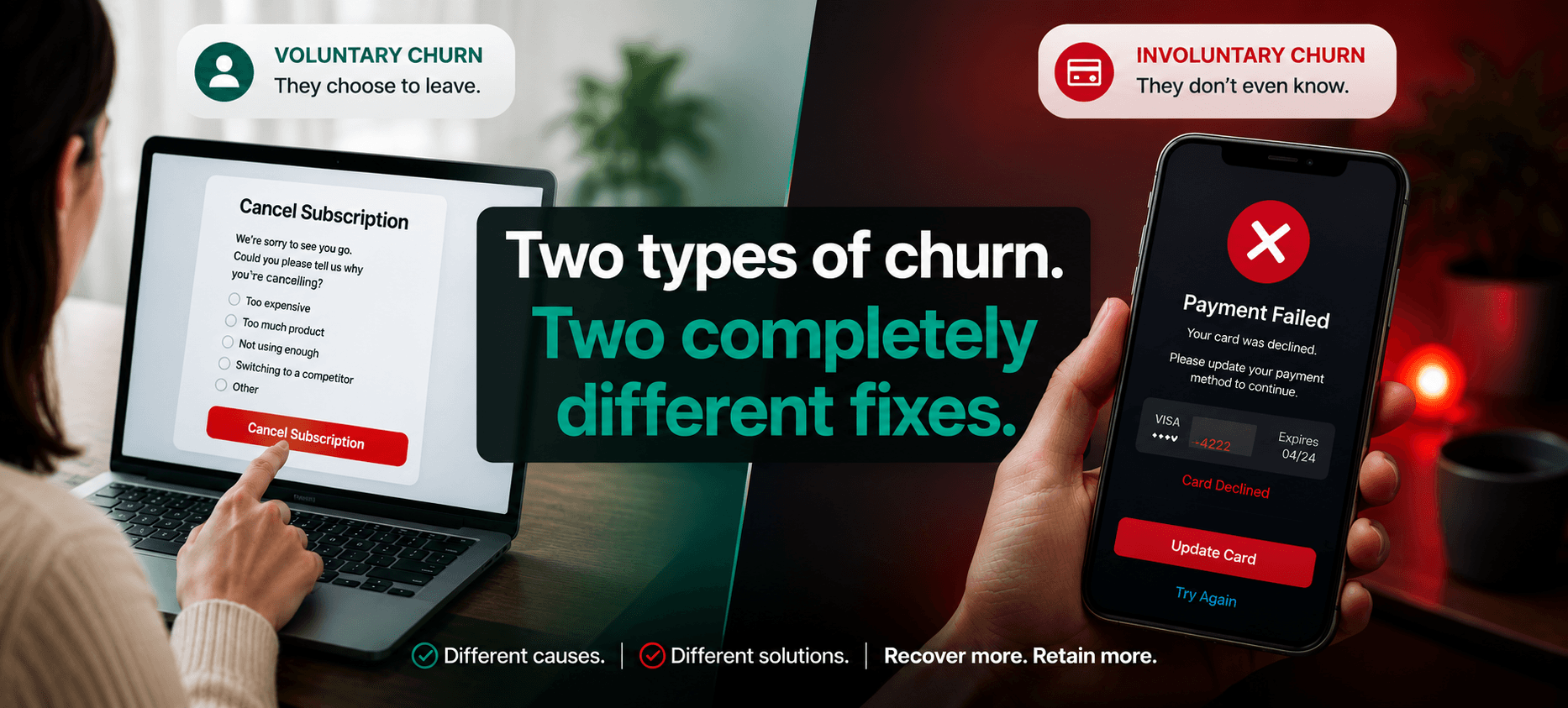
Churn is a term used to describe customers discontinuing their subscription services. Subscriber churn splits into two very different problems, and treating them the same is the first mistake most brands make.
Voluntary churn is a decision. The customer felt the product wasn’t worth it, had a bad support experience, found a cheaper alternative, or simply stopped using what they signed up for.
Involuntary churn is not a decision at all. It’s the customer who still wants the product but loses access because a payment failed — an expired card, a temporary insufficient-funds hold, a bank that flagged the transaction. They don’t cancel. They just quietly stop being a subscriber.
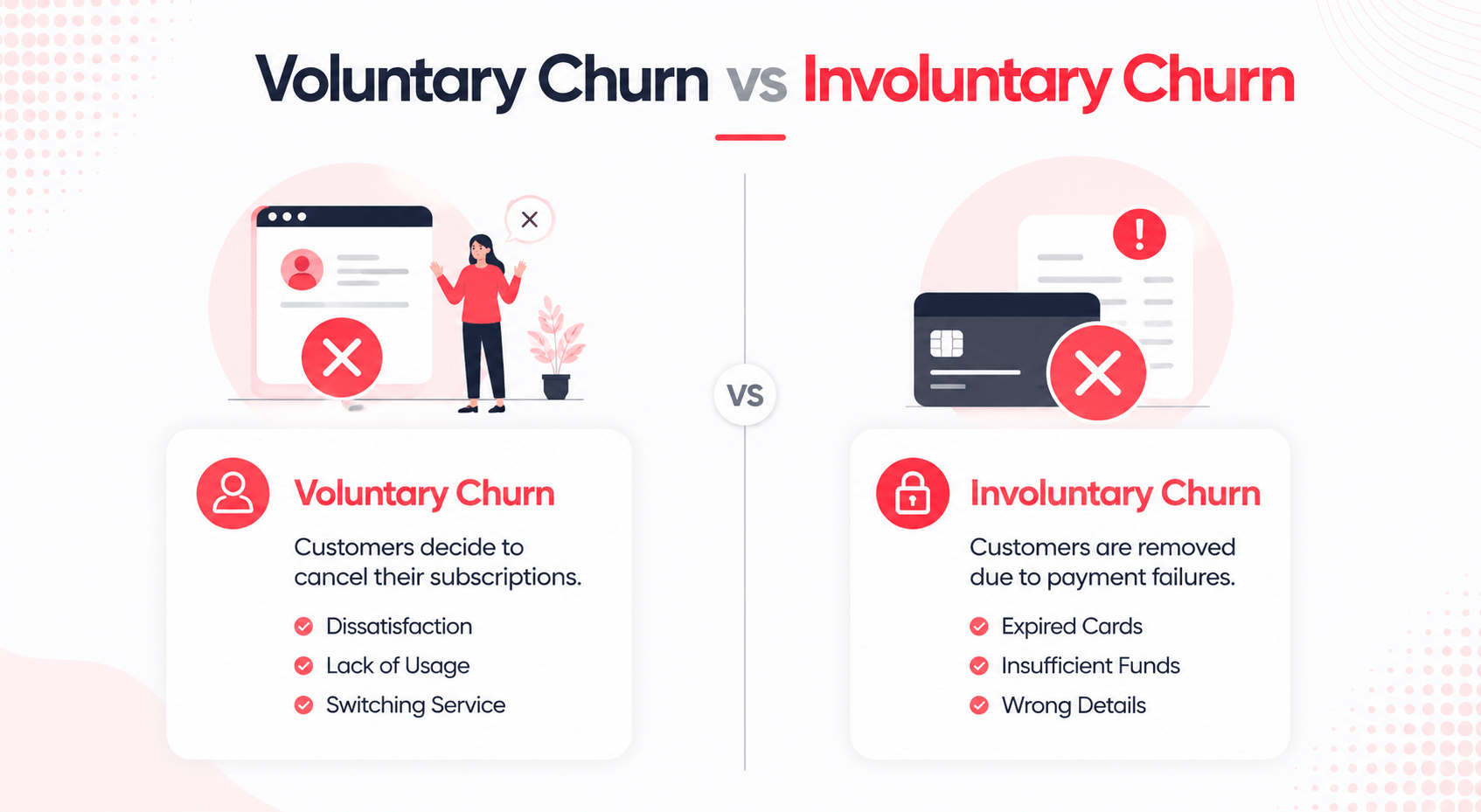
The reason involuntary churn deserves more attention than it usually gets is scale. Involuntary churn accounts for an estimated 30-40% of total churn across subscription businesses, and it’s arguably the most fixable slice of the churn problem, because the customer never actually wanted to leave. For a deeper breakdown of how the two interact and why brands need dual-mode recovery strategies, see our post on voluntary vs. involuntary churn.
Not All Declines Are the Same
Older dunning tools tend to lump every failed payment into one bucket and retry it on a fixed schedule — day 3, day 7, day 14, regardless of why it failed. That’s the single biggest mistake in payment recovery, because a card that’s temporarily out of funds and a card that’s been cancelled need completely different responses.
There are really four categories worth knowing:
Soft declines are temporary. Insufficient funds, a daily spending cap, a velocity block from too many recent charges. The card itself is still valid, and a well-timed retry will often succeed without the customer doing anything.
Hard declines are permanent. An expired card, a card reported lost or stolen, or an account closed by the bank. No amount of retrying will fix this; the customer needs to provide a new payment method.
Authentication required shows up mostly with European banks under SCA/PSD2 rules, where the bank needs the customer to actively verify the charge before it clears. This isn’t a card problem at all, so a generic “update your payment” message is the wrong message entirely. The customer needs a clear path to authenticate, not a card form.
Ambiguous failures are the error codes that don’t map cleanly to any of the above, a non-standard response from a processor or issuing bank. These are common enough that ignoring them means guessing, and guessing wrong either wastes retry attempts on a dead card or misses a recoverable one.
Getting this classification right before taking any action is what separates a system that recovers revenue from one that just annoys subscribers with the wrong message at the wrong time.
Payment networks also continue to evolve recurring payment guidance to improve payment success rates, reduce customer friction, and create a better experience for subscription billing.
Top Reasons Subscription Payments Fail
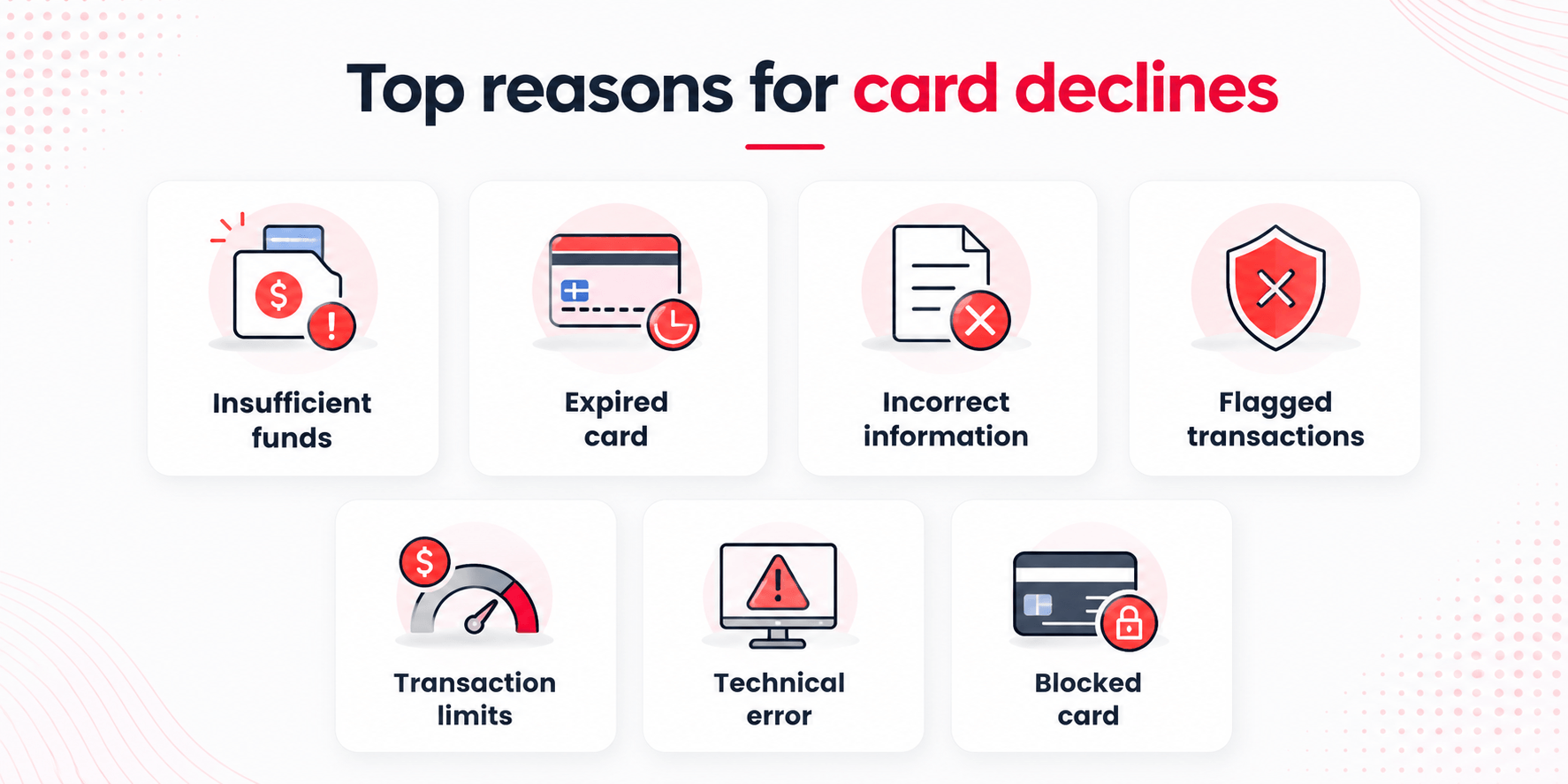
Insufficient funds. The most common cause of all. A subscriber’s account balance dips below the charge amount, often because several recurring payments land in the same window. Insufficient funds is responsible for close to half of all failed transactions globally, which makes timing, not just retrying, the real lever here.
Expired cards. Cards have a shelf life, and customers forget to update them. Roughly 12% of declines trace back to expired cards that were never updated. This is one of the most predictable failures in the entire system, since the expiry date is known well in advance.
Incorrect payment information. Typos in card numbers, CVVs, or expiration dates during checkout or a card update. About 8% of declines come down to simple data entry errors.
Fraud detection triggers. Banks decline transactions that look unusual — a customer travelling abroad, a sudden change in spending pattern. Roughly 20% of declines in 2025 were fraud-protection triggers, and a meaningful share of those are false positives on legitimate subscribers.
Transaction limits. Daily or per-transaction caps on the card get hit, especially around high-spend periods like holiday sales.
Technical and processor errors. Network hiccups between the merchant, processor, and issuing bank that have nothing to do with the customer’s ability to pay.
Blocked cards. Repeated failed PIN attempts or suspected fraud can get a card temporarily frozen by the issuer, independent of the merchant entirely.
Understanding this breakdown matters because each of these has a different fix. Lumping them together is exactly how brands end up retrying dead cards and giving up on recoverable ones. For the tactical playbook on where the recoverable recurring revenue actually sits, see 85% of failed payments are recoverable.
How to Reduce Payment Failures
A few fundamentals apply regardless of what platform or recovery tooling a brand is running:
- Retry with intent, not on a fixed clock. A retry the moment a paycheck typically lands recovers more than a retry three days later on a rigid schedule.
- Get ahead of card expiry. Sending a heads-up before a card expires is far cheaper than recovering the failure after it happens.
- Reduce friction in card updates. The easier it is to fix a card in two clicks, the fewer customers abandon the process.
- Don’t let fraud filters catch honest customers. Legitimate transactions that look unusual (travel, a larger-than-normal order) still need a fast path to confirm and complete.
- Communicate clearly and specifically. A message that explains why a payment failed converts better than a generic “there was a problem with your payment.”
- Test your payment stack regularly. Processor-side issues are invisible until someone checks.
These principles are the foundation. Where it gets interesting is what happens when you apply AI to each one because a subscriber’s situation (not just the failure code) should shape the response.
Why traditional dunning isn’t enough
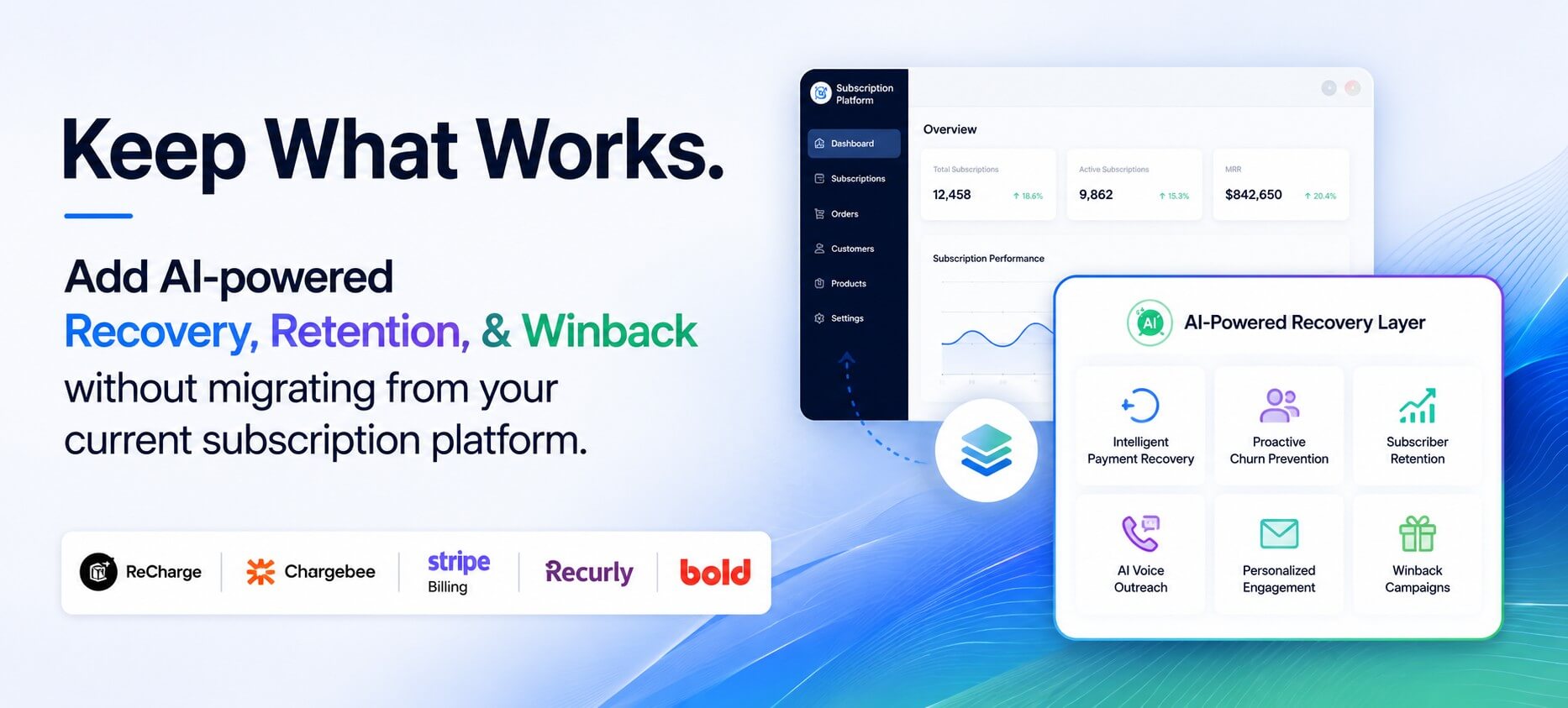
Many subscription brands still rely on traditional dunning workflows that treat every failed payment the same. While this approach can recover some payments, it often misses opportunities because different decline types require different recovery actions. enComm’s AI-powered payment recovery adapts to the reason behind each failure, helping merchants recover more revenue while creating a better subscriber experience.
Generic Dunning | AI-Powered Payment Recovery |
Same retry schedule for every failed payment | Recovery strategy adapts to the decline reason |
Fixed email or SMS reminders | Personalised email, SMS, and AI voice outreach |
Limited payment intelligence | Classifies soft declines, hard declines, and authentication failures |
Reactive recovery | Predictive, context-aware recovery workflows |
Manual optimisation | Continuously optimised recovery timing and messaging |
Lower recovery potential | Higher recovery rates through tailored recovery actions |
How enComm’s Payment Recovery Actually Works
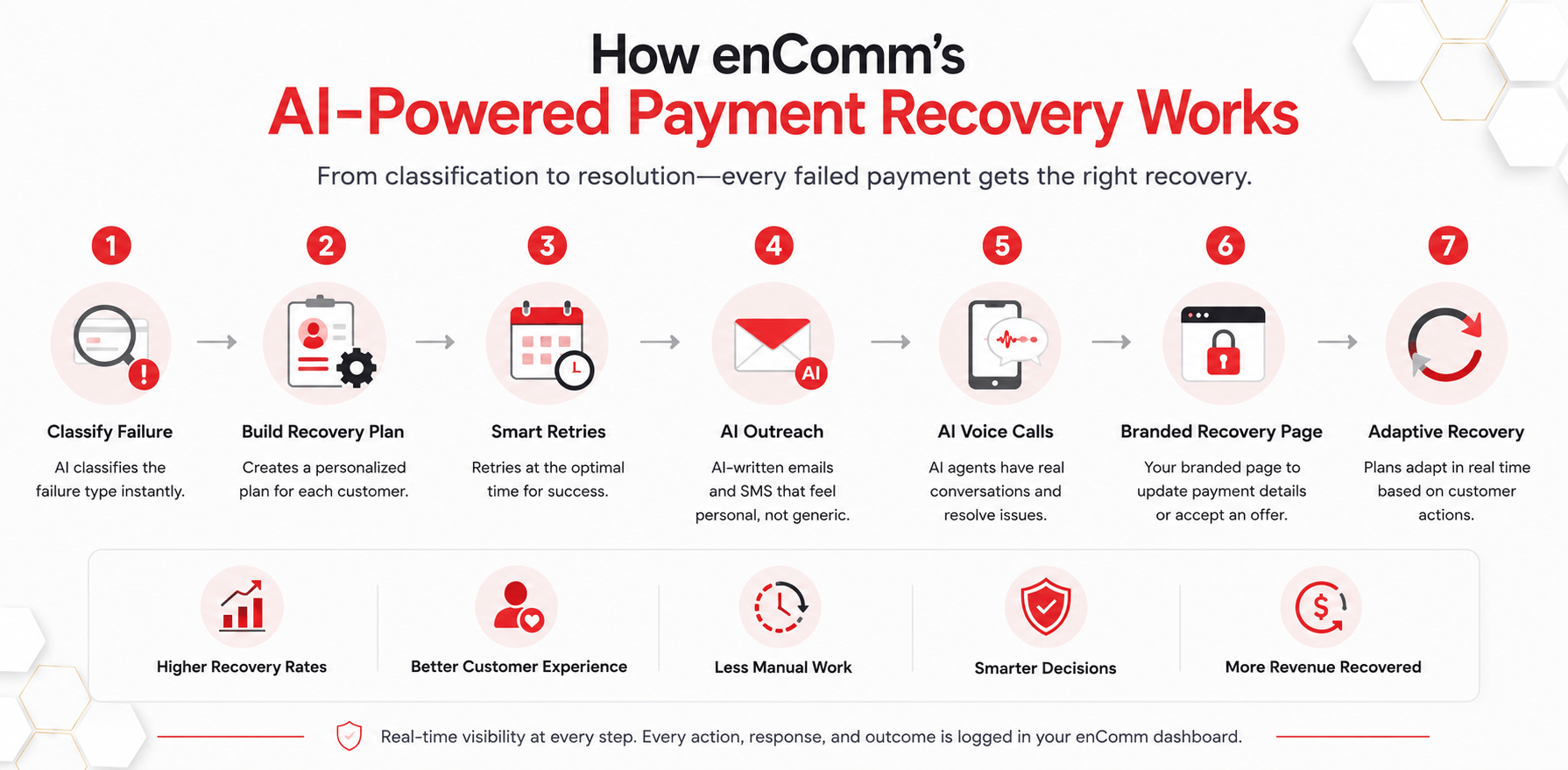
Older dunning tools stop at “retry, email, or SMS.” enComm’s recovery system is built around a different idea: every failed payment is a different situation, and it should be treated that way.
AI Classifies Every Failure Before Anything Happens
Before any retry or message goes out, enComm classifies the failure into one of the four categories above — soft decline, hard decline, authentication required, or ambiguous. For ambiguous cases, an AI model reads the raw error, produces a classification recommendation, and logs an explanation you can see in your dashboard. This step is what prevents wasted retries on dead cards and mismatched messaging on recoverable ones.
Every Customer Gets a Recovery Plan Built for Them
Rather than running every subscriber through the same fixed sequence, enComm looks at the customer’s profile — their value, tenure, how they engage with email, whether they have a phone number on file — alongside the failure type, and builds a recovery plan suited to that specific case. A high-value customer with a card that’s been declined outright gets a faster, more attentive sequence than a low-touch subscriber with a temporary insufficient-funds hold. The plan, and every step in it, is visible in the merchant dashboard before outreach even starts.
Smart-Timed Retries
For soft declines, enComm doesn’t retry on a flat schedule. Retry timing accounts for the type of failure, the customer’s own billing history, and typical banking cycles so retries land closer to when a payment is actually likely to succeed, rather than an arbitrary number of days later.
AI-Written Outreach, Not Templates
Every recovery email and SMS is generated specifically for that customer and that failure, using their name, product, tenure, and the actual reason the payment failed, rather than a template with a name inserted. A long-time subscriber and a new subscriber don’t get the same email.
AI Voice Calling
For cases where email and SMS haven’t resolved the issue or for high-value customers, as an earlier step, enComm can place an AI-powered outbound call. This is a real, adaptive voice conversation, not a robocall: the agent can walk the customer through updating their card, answer subscription questions, and offer a retention deal on the spot if the customer is considering cancelling. Calls only happen within your configured hours, and every call is recorded with a full transcript available on the dashboard.
A Branded Recovery Page
Every recovery email, SMS, and call ultimately points the subscriber to a hosted recovery page, branded to your store, where they can securely update the payment, card details, or accept an offer without any unknown redirect or login requirements.
Everything Adapts as It Happens
If a customer updates their card mid-sequence, the remaining outreach steps stop, and a confirmatory retry runs immediately. If an email bounces, remaining email steps are suppressed. If a customer replies STOP to an SMS, all SMS steps end. Nothing keeps contacting a customer who’s already resolved the issue.
Human Outreach — Available as an Add-On, Not a Default
It’s worth being precise here: enComm’s automated recovery sequence itself doesn’t route customers to a live call center. The automation runs on smart retries, AI-generated email and SMS, and AI voice calls. That said, plenty of brands run their own call center operations and still want a single source of truth for subscriber data. For those brands, enComm connects via API so a call center team can create and update orders, look up subscription and payment history, and support customers directly, running alongside, not replacing, the automated recovery engine. It’s a layer brands can add on top when they already have (or want) a human team in the loop, not a required part of how enComm resolves failed payments.
The Bottom Line – Why Every Failed Payment Needs Different Recovery Strategies
Failed payments are one of the most fixable revenue leaks in subscription commerce but not every failed payment should trigger the same response. Some declines are temporary and resolve with a well-timed retry, while others require the subscriber to update their payment method or complete bank authentication. Treating every decline identically often leads to unnecessary retries, poor customer experiences, and avoidable subscriber churn. Modern payment recovery systems classify payment failures first, then match each one with the most appropriate recovery action, whether that’s a smart retry, a secure card update request, or an authentication prompt. By separating payment recovery strategies based on the reason for failure, subscription businesses can recover more recurring revenue, reduce involuntary churn, and improve the overall subscriber experience without increasing operational complexity.
If you’re evaluating what a modern recovery stack should include beyond retries, our post on how AI replaces 5 different retention tools walks through the gap in outcomes directly.

Frequently Asked Questions
A soft decline is temporary — insufficient funds, a spending limit, a velocity block — and the card is still valid, so a well-timed retry usually works. A hard decline is permanent, like an expired or cancelled card, and requires the customer to provide new payment information.
Fraud detection triggers, technical processor errors, authentication requirements from the bank, and simple data entry mistakes can all cause a decline even when funds are available.
Not if it’s done right. A well-timed retry on a soft decline typically resolves silently, with the customer never noticing an issue. Problems arise when brands retry indiscriminately, including on hard declines that will never succeed.
Yes. Payment gateways return specific payment decline codes that help identify why a transaction failed, allowing recovery systems to choose the most appropriate next action. An AI model interprets the raw error and provides a confidence-scored recommendation, which is far more reliable than treating every failure the same way.
enComm’s own automated recovery sequence uses smart retries, AI-generated email and SMS, and AI voice calling — not a live call center. Brands that run their own call center operations can connect through enComm’s API to manage orders and support customers alongside the automated system, but that’s an optional add-on rather than part of the core recovery flow.
Proactive card-expiry reminders, pre-billing notifications, and smart retry timing catch a large share of failures before they ever become a lost subscriber. Pairing that with fast, low-friction card updates closes most of the remaining gap.