If you're setting up a subscription program on Shopify, the billing model you choose shapes your cash flow, your churn rate, and how much work your team spends chasing failed payments. Most brands default to standard monthly recurring billing without weighing the alternatives — a missed opportunity, since prepaid plans, recurring billing, and trial periods each solve a different business problem, and the best programs usually blend more than one.
Here's what each model does, when to use it, and what to look for in a platform that can run all three without a patchwork of apps.
What are subscription billing models?
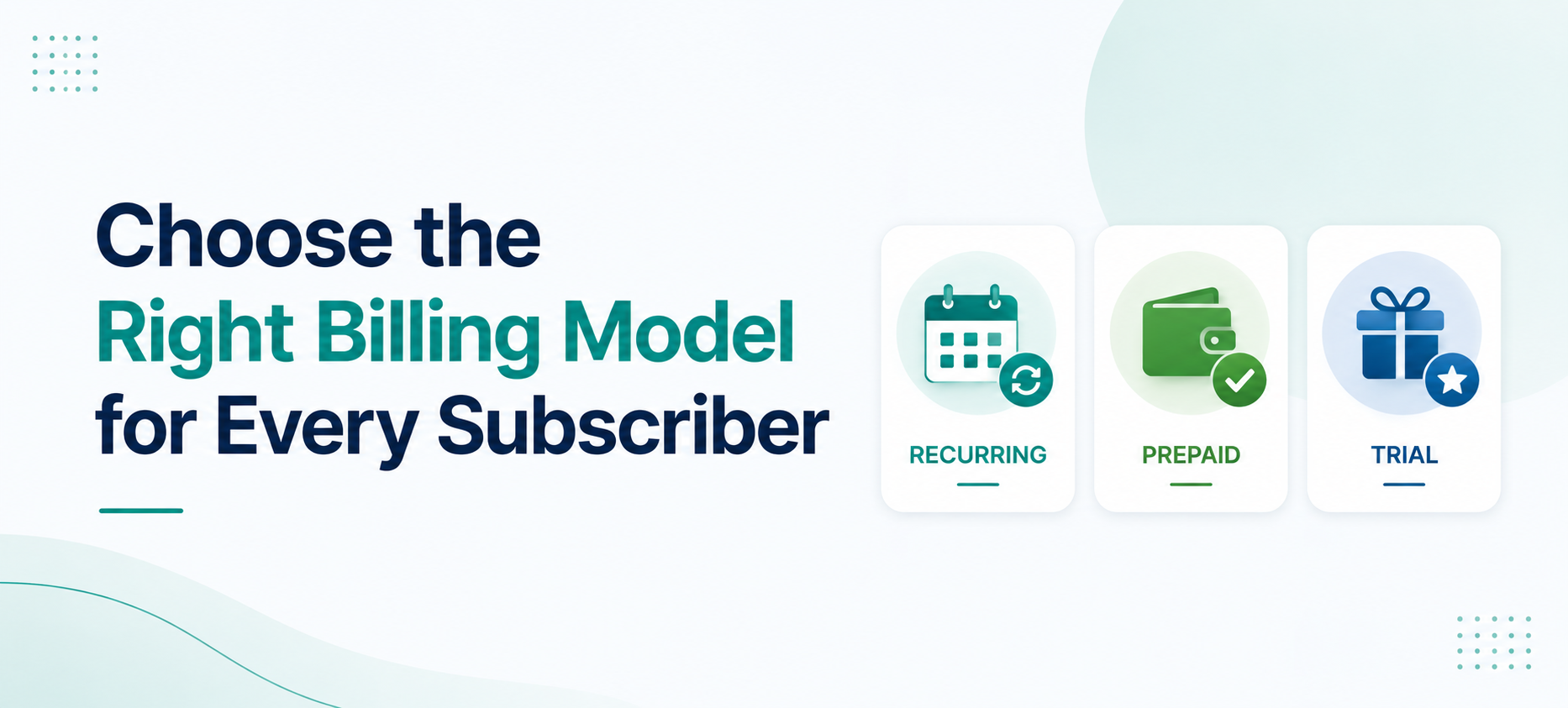
Subscription billing models determine how and when customers are charged for recurring purchases. The three most common models are recurring billing, prepaid billing, and trial-based subscriptions. Each affects customer acquisition, cash flow, churn, and payment recovery differently, so many Shopify brands combine multiple billing models rather than relying on just one.
Recurring Billing: Benefits, Drawbacks & When to Use It
Recurring billing charges the customer on a fixed cadence — weekly, monthly, quarterly — for as long as the subscription stays active. It's the model most people picture when they hear "subscription," and it's the right starting point for replenishment products: coffee, supplements, pet food, skincare.
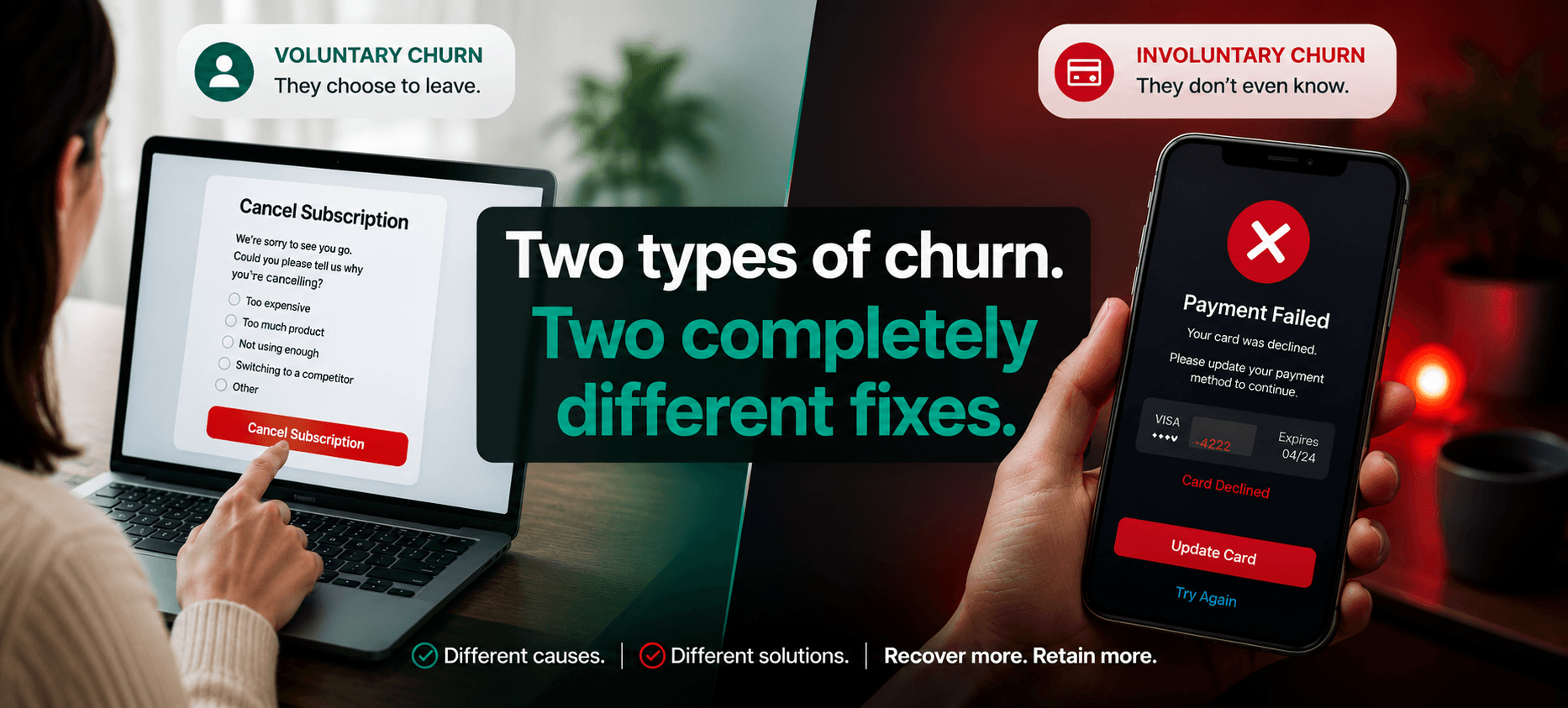
The appeal is simplicity for the customer: cancel anytime, no big upfront commitment. The tradeoff is that recurring billing carries the most exposure to involuntary churn — subscribers who don't mean to leave but get bounced out because a card expired or a bank declined the charge. According to Recurly's 2026 State of Subscriptions, based on data from 2,200 merchants and 76 million subscribers, annual plans generate 50–60% higher revenue per subscriber than monthly plans, making prepaid and annual billing compelling options for merchants looking to improve cash flow and customer lifetime value.
None of that means recurring billing is the wrong choice. It just means it needs strong payment recovery underneath it, which is a separate conversation — see our complete guide to subscription retention and revenue recovery for how that works.
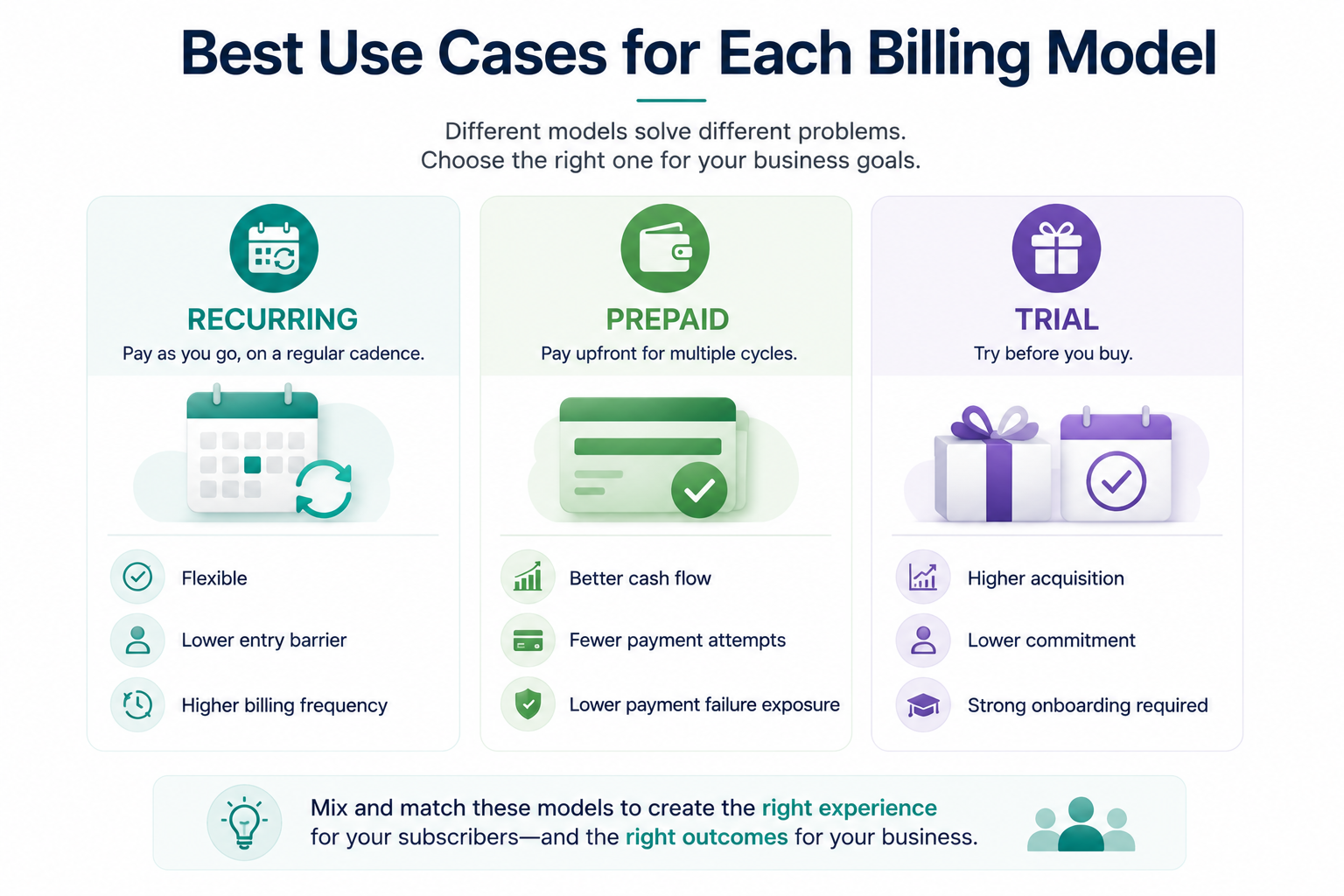
Recurring billing offers flexibility but creates the most billing events. Prepaid billing improves cash flow and reduces payment opportunities. Trial subscriptions increase acquisition but require strong onboarding. Most Shopify subscription businesses achieve the best results by combining all three billing models within a single subscription platform.
Prepaid Billing: Better Cash Flow, Fewer Billing Events
Prepaid billing charges the customer upfront for a block of future cycles — three months, six months, a year — instead of billing each cycle individually. The customer still receives their product on the normal delivery schedule; only the payment timing changes.
Two things make prepaid attractive. First, cash flow: you collect revenue today instead of spreading it across months of billing attempts that may or may not succeed. Second, fewer billing events mean fewer chances for a card to fail — a subscriber billed once for six months has one point of payment risk instead of six. Research from Zuora's Subscription Economy shows that longer customer commitments improve revenue predictability and customer lifetime value, making prepaid subscription plans an attractive option for many subscription businesses.
Prepaid isn't free of tradeoffs — it asks for more commitment at checkout, which can suppress conversion if it's the only option offered. It works best alongside monthly billing, not as a replacement: let price-sensitive customers start monthly, and let convinced customers opt into a prepaid term at a discount.
Trial Subscription Models: Free Trials vs Discounted First Orders
A trial period delays the first full charge — a free trial, a discounted first cycle, or a set number of days before billing begins. It exists to solve a conversion problem, not a retention problem: getting someone to say yes to a subscription they haven't tried yet.
Trials work, but the data shows real variation. Free trials convert new subscribers at roughly 15 to 25%, while a discounted first box tends to convert stronger, at 25 to 40%, with better follow-on retention than free trials. A trial isn't automatically better than a modest first-order discount — the right choice depends on your product and price point.
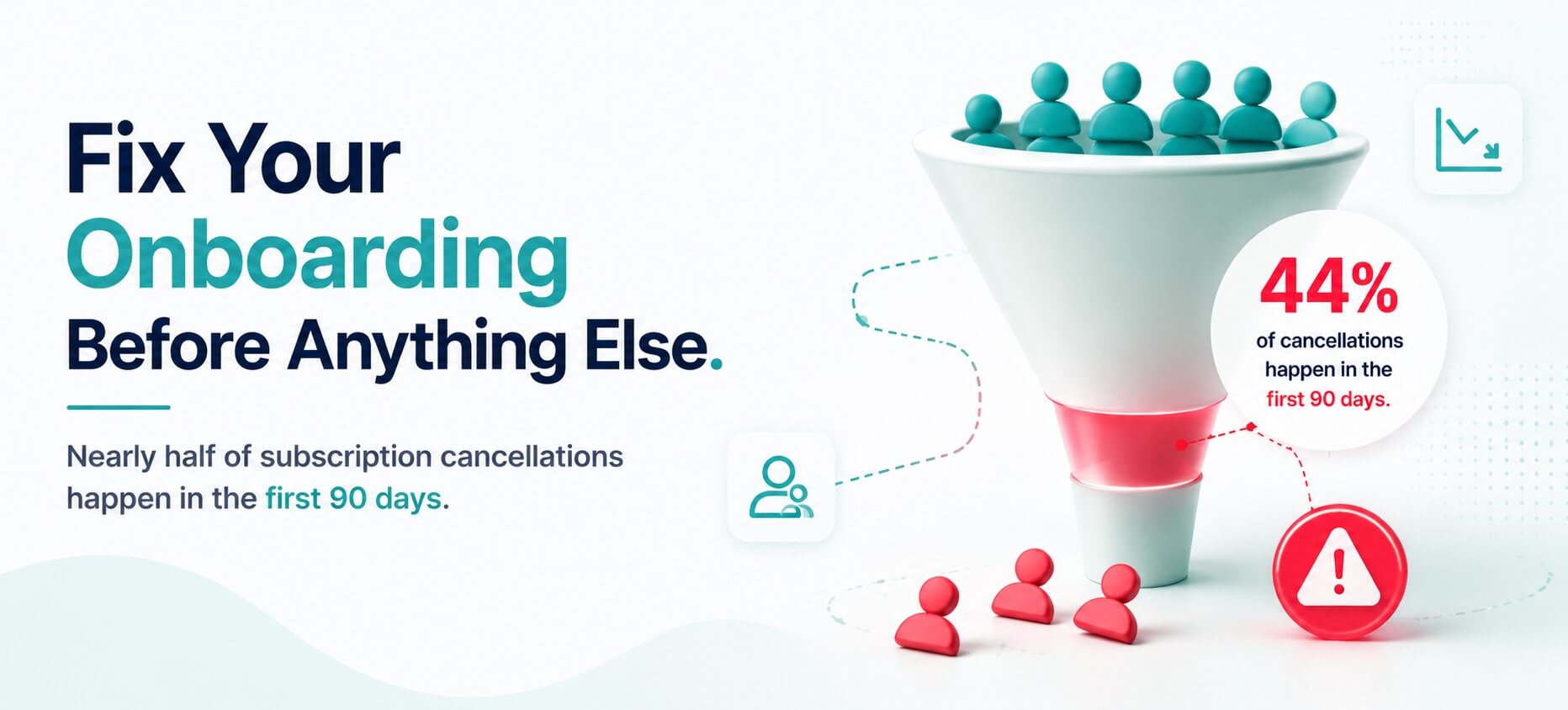
Trials also shift where your churn risk shows up. Instead of failed payments, the risk is early cancellation right after the trial converts to a paid cycle — which ties closely to onboarding. We cover that pattern in more depth in why 44% of cancellations happen in the first 90 days.
Managing Recurring, Prepaid and Trial Billing in Shopify
Most Shopify subscription brands need more than one of these models at once — monthly for flexibility, prepaid for committed customers, a trial or discounted first box for new acquisition. Many subscription apps handle one of these well and treat the rest as an afterthought, which is often why brands end up stacking a subscription app, a separate billing tool, and a manual process to cover the gaps. We cover that pattern in how AI orchestration replaces five separate Shopify apps for subscription brands.
enComm's subscription management is Shopify-native, which means all three billing models live inside the same selling plan infrastructure rather than bolted-on workarounds:
- Recurring billing on any interval — weekly, monthly, quarterly, or a custom cadence — with min/max cycle commitments if you want to require a minimum term.
- Prepaid billing, where you set the number of cycles to charge upfront and a deposit type (percentage or fixed) if you want a partial charge at checkout.
- Trial periods of any length before the first full charge, plus deferred billing if you want to schedule the first charge for a future date entirely.
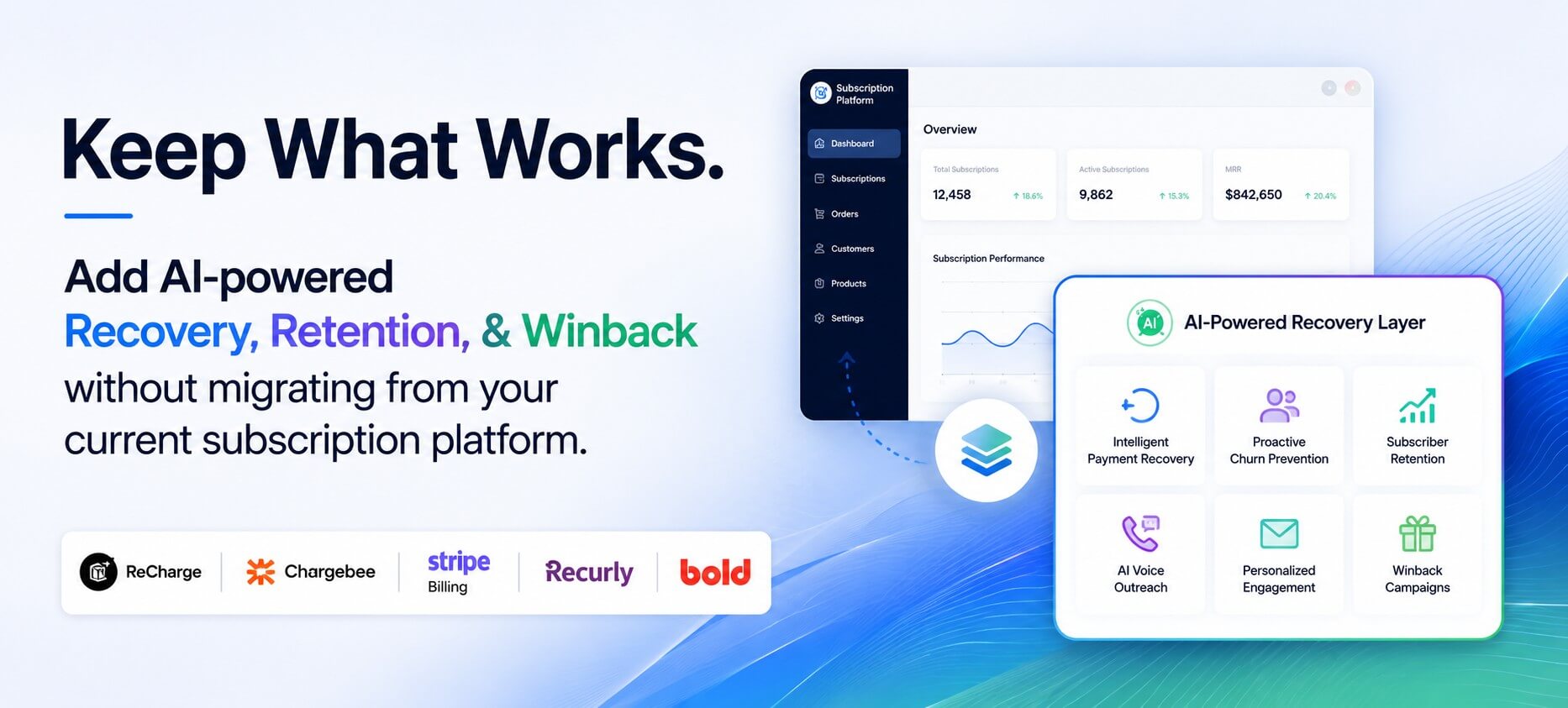
Because every selling plan lives directly in Shopify's subscription infrastructure, a customer can be offered monthly, prepaid, and trial options on the same product page, and each contract bills correctly from day one — no separate sync, no reconciling two systems. Merchants on ReCharge or Chargebee weighing whether to add AI-powered recovery on top of their existing billing setup can see how that layering works in what AI-powered retention adds on top of ReCharge or Chargebee.
Whichever mix you choose, the billing model is only half the equation — how you handle the payments that don't go through on the first try is what actually protects the revenue you've already earned.
Why billing models matter
Choosing the right subscription billing model isn't only about pricing. Billing frequency directly affects customer commitment, payment failure risk, cash flow, and long-term retention. Modern subscription platforms allow merchants to combine recurring, prepaid, and trial plans so each customer can choose the option that best fits their buying journey while merchants maintain a single subscription management workflow.